





GDPR Certification in Philippines
A single contract with a European client can bring the EU’s data protection law into a Philippine office. So can an online store that ships to Germany, or an app that tracks users in France. GDPR certification in Philippines is how local organizations show those clients, and EU regulators, that personal data is handled to European standards.
Univate Global builds GDPR compliance programs for Philippine controllers and processors, then prepares them for independent assessment. We work out whether and how the regulation applies to you. Then we close the gaps, document the evidence and line up the right form of external assurance for your buyers.
Our work runs alongside your existing Data Privacy Act program rather than replacing it. Most Philippine organizations already have a Data Protection Officer, privacy notices and some security controls. We build on that foundation, so you meet both laws with one set of records instead of two parallel systems.
Free ConsultationContact Us
Our Clients









GDPR Certification in the Philippines for IT-BPM, Banking, Healthcare and Exporters
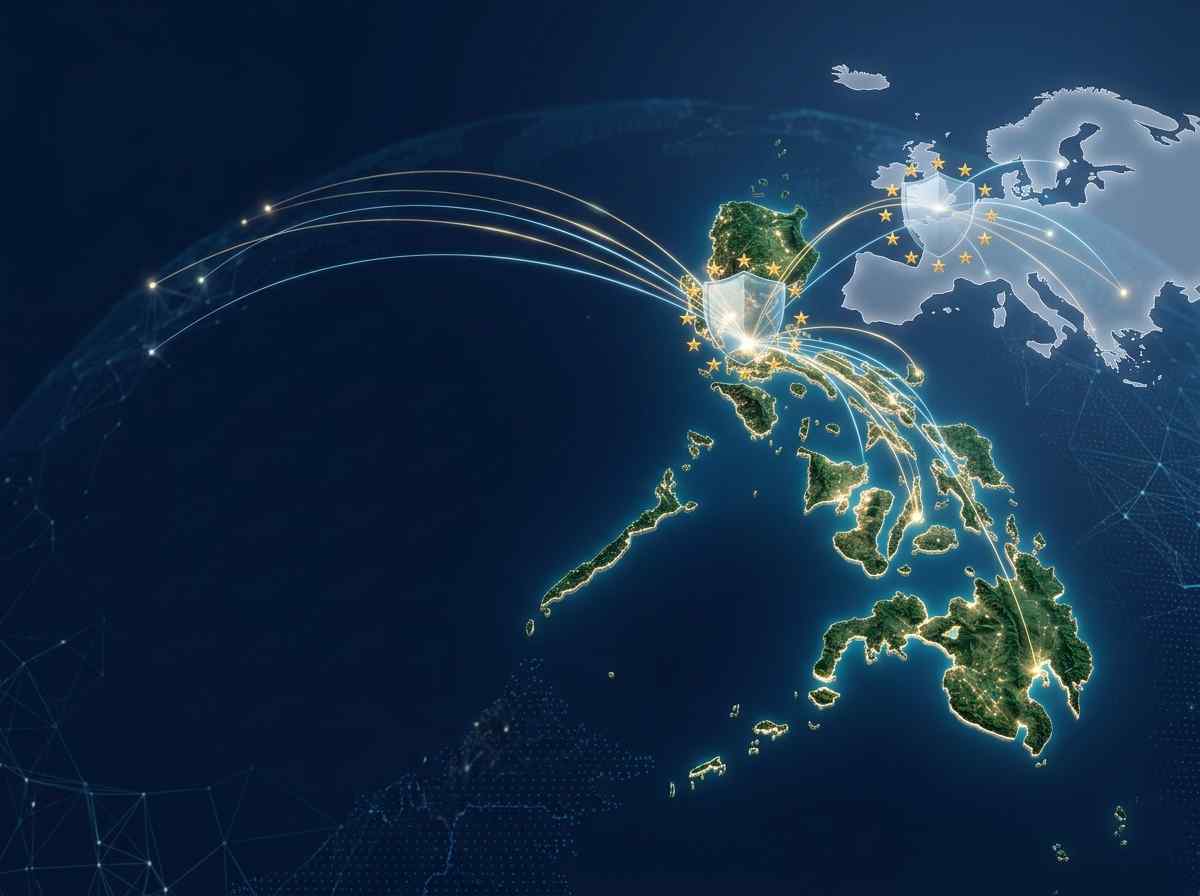
The GDPR follows the data, not the company’s address. A Philippine organization may fall within its reach by handling EU personal data for a European client. Targeting EU residents directly has the same effect. Nationally, the demand comes from six broad groups.
IT-BPM operators are the largest. Contact centers, back-office teams and knowledge process firms often serve European banks, insurers, airlines and retailers. Their clients sign data processing agreements that pass GDPR duties down to the Philippine delivery site.
Software, SaaS and IT services companies come next. A European customer evaluating a Philippine platform will ask where data is hosted, who can access it and how a breach would be reported. A documented GDPR program answers those questions before procurement stalls.
Banks, fintechs and payment firms serving overseas Filipinos and European partners also need clear rules for EU data. Healthcare organizations, medical transcription providers and health-tech startups handle special category data, which carries the strictest GDPR conditions. Even a small volume of EU health records can trigger a DPIA and tighter access rules.
Manufacturers and exporters hold EU buyer contacts, distributor records and sometimes employee data from European subsidiaries. Universities recruiting students from Europe, and government agencies working with EU partners, round out the list. Each group touches the GDPR in a different way, so the program must start from your actual data flows. That is why every engagement for GDPR certification in Philippines begins with a map of who you serve and what data crosses the border.
How GDPR Certification Works in the Philippines
The General Data Protection Regulation, Regulation (EU) 2016/679, has applied since 25 May 2018. It governs how organizations collect, use, store, share and delete personal data about people in the European Union.
One point deserves a plain answer early. There is no single, mandatory GDPR certificate that every organization must hold. Article 42 of the regulation allows approved certification mechanisms. Europrivacy, for example, was approved by the European Data Protection Board as a European Data Protection Seal in 2022. In practice, though, most organizations prove compliance differently. They run a documented compliance program, commission an independent assessment, and often add ISO/IEC 27701 certification for their privacy management system.
So when buyers ask for “GDPR certification”, our service delivers two things. First, a working GDPR compliance program built around your processing. Second, readiness for whichever independent assessment your clients will accept. Univate is a consultant. We do not issue Article 42 certificates, and the parties who assess you remain independent of us.
The assessor depends on the route. An independent GDPR assessment is carried out by a privacy audit firm outside your organization. ISO 27701 certification comes from an accredited certification body. An Article 42 seal such as Europrivacy is awarded by a certification body accredited for that scheme. Each route tests the same underlying evidence, so a solid program prepares you for any of them.
Why Philippine Businesses Invest in GDPR Certification
Contracts drive most projects. Under Article 28, an EU controller may use only processors that give sufficient guarantees of appropriate measures. European clients therefore send detailed questionnaires and audit rights clauses to Philippine vendors. A vendor with evidence ready wins time and trust.
Exposure is the second driver of GDPR certification in Philippines projects. Fines can reach €20 million or 4% of worldwide annual turnover, whichever is higher. Clients also pass liability down through indemnities, so a Philippine supplier can feel the cost of a European breach directly.
GDPR and the Philippine Data Privacy Act Compared
Philippine organizations already work under the Data Privacy Act of 2012 (Republic Act 10173), enforced by the National Privacy Commission (NPC). The two laws share a lot of ground. Both expect a designated Data Protection Officer, appropriate security measures and prompt breach notification. NPC Circular 16-03 sets a 72-hour window for notifying the Commission, which mirrors the GDPR’s 72-hour rule under Article 33.
The differences matter just as much. Scope is the first. The GDPR is extraterritorial under Article 3(2), reaching Philippine organizations that offer goods or services to people in the EU or monitor their behavior. Such organizations usually also need an EU representative under Article 27, a role with no Data Privacy Act equivalent.
Lawful basis is the second difference. The GDPR requires a lawful basis for every processing purpose, recorded and explained to individuals. The Data Privacy Act sets its own criteria for processing personal and sensitive personal information. A basis that works locally may need re-examination before it is relied on for EU data.
Transfers are the third. The Philippines has no EU adequacy decision. Personal data leaving the EU for a Philippine site therefore needs safeguards, usually the 2021 Standard Contractual Clauses plus a transfer risk assessment. The DPO role also differs. The Data Privacy Act expects organizations to designate one, while the GDPR mandates a DPO only in the cases set out in Article 37.
Terminology differs too, which causes confusion in contracts. The Data Privacy Act speaks of personal information controllers and processors, and of sensitive personal information. The GDPR uses controllers, processors and special categories of personal data. The ideas are close but not identical, so contract clauses should use the right term for each law.
Supervision is the final contrast. The NPC is your regulator at home. Under the GDPR, a supervisory authority in an EU member state may act on complaints from individuals there. Your EU representative becomes the contact point for those authorities.
The practical answer is one integrated program. We map each GDPR duty against its Data Privacy Act counterpart, keep shared records once and add only what Europe requires. As the national hub, this page connects to our city services for GDPR certification in Cebu and GDPR certification in Manila.
GDPR Requirements: What Your Organization Will Need
The regulation describes outcomes rather than a fixed checklist. A twelve-person SaaS startup and a large contact center will meet them in very different ways. Still, any credible assessment will look for these core obligations:
- A lawful basis identified and recorded for each purpose for which personal data is used
- Clear, accessible privacy information telling people what happens to their data and why
- A working process for access, correction, erasure, objection, portability and other data subject requests
- Records of processing activities under Article 30, kept current for every system and vendor
- Data protection by design and by default under Article 25, built into new projects and changes
- Security of processing under Article 32, proportionate to the risk to individuals
- A breach response plan able to notify the supervisory authority within 72 hours where Article 33 applies
- Data protection impact assessments under Article 35 for high-risk processing, plus a DPO where Article 37 requires one
Paper alone will not pass an assessment. Assessors sample records, test request handling and question staff on what they actually do with customer data. We therefore spend as much effort on everyday practice as on drafting policies.
Leadership involvement is just as important. Accountability is a core GDPR principle, and senior management must own the program. Projects move fastest with a named sponsor and a small working group from legal, IT, HR and operations.
Our Process for GDPR Certification in the Philippines
We deliver GDPR certification in the Philippines through six connected stages. Each stage produces something your team can use, and nothing is left as a draft that never reaches daily operations.
Step 1 – Applicability and Role Assessment
We first establish whether the GDPR applies and in what capacity. Are you a controller targeting EU residents, a processor serving EU clients, or both? The answer shapes every later step, including the need for an EU representative and the contracts you must sign.
Step 2 – Data Mapping and Gap Analysis
Next, we trace EU personal data through your systems, teams and vendors. That map becomes your Article 30 records. We then compare current practice against both the GDPR and the Data Privacy Act, giving you one prioritized list of gaps.
Step 3 – Legal Basis, Notices and Contracts
We help you confirm lawful bases, rewrite privacy notices and review data processing agreements with clients and subprocessors. Where EU data comes to the Philippines, we work with your legal advisers on Standard Contractual Clauses and transfer risk assessments.
Step 4 – Security and Privacy Controls
We align technical and organizational measures with Article 32. Typical work includes access control, encryption, logging, retention and secure deletion. Vulnerability assessment and penetration testing provide evidence that controls hold up. We also run DPIAs for high-risk processing and embed privacy by design into change management.
Step 5 – Rights Handling, Breach Drills and Internal Audit
Your team practices answering data subject requests and runs a tabletop breach exercise against the 72-hour clock. The drill tests who decides, who drafts the notice and who tells the EU client. Staff receive role-based training, with extra depth for agents who handle EU customer calls. We then conduct an internal audit of the whole program and support management in reviewing the results.
Step 6 – Independent Assessment and Ongoing Compliance
Finally, we prepare you for the external route your clients prefer. That may be an independent GDPR assessment, an ISO 27701 audit by an accredited certification body, or an Article 42 scheme such as Europrivacy. Afterward, we can support annual reviews, vendor checks and updates as the law evolves.
Typical GDPR Timeline for Philippine Organizations
The table below gives indicative durations for a mid-sized organization with one main site. Actual timing depends on the number of processing activities, systems and EU clients involved.
| Phase | Key activities | Indicative duration | Main output |
|---|---|---|---|
| Applicability and mapping | Role assessment, data flow mapping, stakeholder interviews | 2–3 weeks | Applicability memo and Article 30 records |
| Gap analysis | Comparison against GDPR and Data Privacy Act duties | 1–2 weeks | Prioritized gap register and roadmap |
| Legal and contractual work | Lawful bases, notices, processing agreements, transfer safeguards | 3–6 weeks | Updated notices, contracts and transfer file |
| Controls and DPIAs | Security measures, retention, privacy by design, DPIAs | 6–10 weeks | Implemented controls and DPIA reports |
| Testing and internal audit | Request handling tests, breach drill, training, internal audit | 2–3 weeks | Audit report and closed findings |
| Independent assessment | External GDPR assessment, ISO 27701 audit or Article 42 scheme | 3–8 weeks, including scheduling | Assessment report or certificate |
Most organizations reach assessment readiness in four to seven months. Groups with many EU clients, several Philippine sites or heavy use of special category data may need longer.
GDPR Certification in the Philippines: Cost and Timeline
No honest provider can price GDPR work before understanding your processing. A processor handling one client’s HR records faces a smaller task than a controller running a consumer app across Europe. These GDPR-specific factors drive the cost of GDPR certification in Philippines projects.
Your Role and Number of Processing Activities
Controllers carry broader duties than processors, including lawful basis decisions and direct communication with individuals. Each additional processing activity or EU client adds mapping, documentation and contract review.
Data Sensitivity and DPIA Workload
Health data, biometric data, data about children and large-scale monitoring all raise the bar. Each high-risk activity may need its own DPIA, and some need extra safeguards before processing can continue.
Transfers, Vendors and Entities in Scope
Every cross-border flow needs a documented safeguard, and every subprocessor needs a reviewed agreement. Groups with several legal entities or many cloud vendors need more transfer and contract work. Onward transfers matter as well. A Philippine processor that relies on a support desk in another country must cover that leg too.
Your Chosen Assurance Route
Consulting fees cover building and preparing the program. External fees depend on the route. These include an independent assessor’s fee, an ISO 27701 certification body’s audit fee, or an Article 42 scheme’s fees.
If you choose ISO 27701, select a certification body accredited by the Philippine Accreditation Bureau or another International Accreditation Forum member. Article 42 schemes are run by certification bodies accredited under Article 43 of the GDPR. We will explain which route your clients are most likely to accept and give you an itemized quote.
On timing, most mid-sized programs take four to seven months from kickoff to assessment. The biggest variable is how quickly legal, IT and business owners review drafts and supply evidence. For background on the regulation itself, see our main GDPR page.
Benefits of GDPR Certification for Philippine Businesses
A well-run GDPR program pays off beyond the assessment report. Most organizations see commercial and operational gains within the first year.
Faster Sales With European Clients
A ready evidence pack answers vendor questionnaires in days instead of weeks. Sales teams can respond to European tenders with confidence rather than promises.
One Program for Two Laws
Integrating GDPR with Data Privacy Act duties removes duplicated records and conflicting procedures. Your DPO manages one framework, and NPC compliance improves as a side effect.
Reduced Breach and Penalty Exposure
Data minimization, retention limits and stronger security shrink the amount of data that could be exposed. A rehearsed breach process keeps notification within the 72-hour window.
Cleaner, Better Governed Data
Mapping data flows often uncovers forgotten copies, unused systems and over-broad access. Removing them lowers storage costs and makes analytics more reliable. Clear retention rules also make it easier to answer erasure requests quickly.
A Path to Certifiable Privacy Management
The program maps closely to ISO 27701, so certification becomes a natural next step when clients ask for a formal certificate.

Why Philippine Companies Choose Univate for GDPR
Univate has consulted more than 300 enterprises across cybersecurity and compliance. We have delivered more than 500 executive sessions on cybersecurity, AI governance and data privacy. Our consultants include CISA-certified professionals and specialists with decades of experience in security, risk and governance.
Our Philippine office is in Makati, so we know how the Data Privacy Act and NPC expectations work in practice. We have also logged more than 1,000 audit man-days across critical infrastructure and regulated industries. We also understand what European clients look for in a processor. That combination keeps GDPR certification in the Philippines practical rather than theoretical.
Many clients also need ISO 27001 or SOC 2, so we design privacy controls to serve several frameworks at once. As your consultant, we stay independent of the assessor, which keeps the final result credible.
GDPR Certification Services Across the Philippines
We support organizations nationwide through hybrid delivery. Workshops, document reviews and data mapping sessions run remotely. On-site visits are planned for key milestones such as process walkthroughs, breach drills and the internal audit.
In Metro Manila, we work with organizations in Makati, Bonifacio Global City, Ortigas Center, Quezon City, the City of Manila and Alabang. These hubs host many of the BPOs, banks, SaaS firms and shared service centers that serve European clients.
Beyond the capital, we support organizations in Cebu, Davao, Clark and Pampanga, Iloilo, Bacolod, Cagayan de Oro and Baguio. Each region brings its own mix of IT-BPM, exporters, universities and healthcare providers. Every location receives the same structured approach to GDPR certification in Philippines. That holds whether your team sits in a Davao delivery center or a Clark data operation.
Planning GDPR certification in the Philippines?
Tell us about your scope, your sites and your timeline, and we will come back with a clear plan.
Client Testimonials
It was really a great partnership with their team.
Sultan
I had the pleasure and opportunity of working with Univate Solutions on a couple of High Maturity (ML5) CMMI appraisals and found them to be one of the best.
Amulya P
Team Univate holds many professional approaches.
Ashish Sherlekar
GDPR Certification in Philippines: Frequently Asked Questions
What does GDPR certification in Philippines actually involve?
It involves building a documented GDPR compliance program, then having it independently assessed. The assessment may be a GDPR audit, ISO 27701 certification or an approved Article 42 scheme. There is no single mandatory certificate.
Does the GDPR apply if we have no office in Europe?
It can. Article 3(2) covers organizations offering goods or services to people in the EU, or monitoring their behavior. Processors serving EU clients are also bound through their Article 28 contracts.
If we comply with the Data Privacy Act, are we covered for GDPR?
Partly. Both laws require security measures, breach notification and a DPO in many cases. However, the GDPR adds extraterritorial reach, its own lawful basis rules and strict transfer requirements.
Do we need an EU representative?
Usually, if you are a controller or processor caught by Article 3(2). Article 27 requires a representative based in the EU, with limited exceptions for occasional, low-risk processing.
How are EU data transfers to the Philippines handled?
The Philippines has no adequacy decision, so transfers rely on safeguards. Most use the 2021 Standard Contractual Clauses, supported by a transfer risk assessment and appropriate security controls.
How quickly must a breach be reported?
Under Article 33, a controller must notify the supervisory authority within 72 hours where feasible. Processors must tell their controller without undue delay. NPC Circular 16-03 also sets 72 hours for the National Privacy Commission.
Is ISO 27701 the same as GDPR compliance?
No, but it helps a great deal. ISO 27701 certifies a privacy information management system. It provides strong evidence for many GDPR duties, though legal questions such as lawful basis still need separate review.
Can Univate issue our GDPR certificate?
No. Univate is a consultant that builds and prepares your program. Certificates and assessment reports come from independent bodies, which keeps the result credible for clients and regulators.
Is the GDPR about to change?
The EU’s Digital Omnibus proposal from November 2025 would amend parts of the GDPR. It is still in the legislative process, so current obligations apply. We track it and will flag any changes that affect you.
Start Your GDPR Certification Project in the Philippines
Whether a European client has sent a questionnaire or you are planning to enter the EU market, start with a clear view of your obligations. We will assess how the GDPR applies, recommend an assurance route and provide an itemized proposal for GDPR certification in Philippines.
Book a Free Consultation Call +63 963 451 6528Prefer to talk first? Call our Philippines team on +63 963 451 6528, or share your requirements through the contact form.
Email: info@univateglobal.com