




SOC Certification in the Philippines
Independent assurance that your systems, data and service delivery are controlled the way your clients expect. Univate Global supports SOC 1, SOC 2 and SOC 3 readiness for organizations across the Philippines.

Overview of SOC Certification
SOC certification shows that an organization has strong internal controls. These controls protect systems, data and service delivery. In the Philippines, many global clients and regulators ask for SOC reports before they will sign or renew a contract.
Univate Global supports the full SOC journey. We handle readiness checks, control setup, audit preparation and post audit fixes, so your team is not left guessing what an auditor will look for.
Talk to a SOC ExpertWhat Is SOC Certification?
SOC stands for System and Organization Controls. It is a reporting framework created by the American Institute of Certified Public Accountants (AICPA). A SOC engagement reviews how an organization manages security, availability, processing integrity, confidentiality and privacy, and results in a report that can be shared with clients under NDA.
We explain SOC in plain terms and help teams apply controls that work in daily operations, rather than a policy set that only exists for the audit. If you are still comparing frameworks, our guides on what SOC 2 covers and SOC 2 versus ISO 27001 are a useful starting point.
Types of SOC Reports: SOC 1, SOC 2 and SOC 3
Choosing the right report is the first decision, and it depends on what your clients actually need to see.
| Report | What It Covers | Typically Requested By |
|---|---|---|
| SOC 1 | Controls relevant to a client's financial reporting, covering how your services affect their financial statements | Payroll processors, BPO finance and accounting teams, shared services centers, transaction processors |
| SOC 2 | Data security and system protection, assessed against the Trust Services Criteria | SaaS platforms, IT and cloud providers, technology enabled outsourcing firms |
| SOC 3 | A public summary of SOC 2 results that can be shared openly, without the detailed control testing | Organizations wanting a marketing friendly, publicly shareable assurance document |
Univate Global helps organizations choose the right SOC type based on services delivered, client requirements and market expectations in the Philippines. Many companies also need to decide between SOC 2 Type 1 and Type 2 once the report type is settled.
SOC 1 Certification in the Philippines
SOC 1 is often the report that Philippine service providers are asked for first, particularly in the finance and accounting outsourcing space. If your organization runs payroll, processes transactions, manages billing or maintains records that feed into a client's financial statements, your controls form part of their audit trail.
That is why global clients and their external auditors ask for a SOC 1 report. It gives their audit team documented, independently tested assurance over the parts of the process that sit inside your operation.
Finance and accounting BPOs, payroll service providers, claims processors, loan and mortgage servicers, and shared services centers handling client financial data.
SOC 1 focuses on controls that affect financial reporting. SOC 2 focuses on security and the wider Trust Services Criteria. Some organizations in the Philippines need both, because different client teams ask for different assurance.
A Type 1 report assesses control design at a point in time. A Type 2 report tests whether those controls operated effectively across a defined period. Most client audit teams eventually want Type 2.
Why SOC Certification Matters for Businesses in the Philippines
The Philippines is one of the world's largest delivery hubs for IT-BPM, shared services and technology enabled outsourcing. That position brings opportunity and scrutiny in equal measure.
Client contracts depend on it
US, UK and Australian buyers routinely make a current SOC report a condition of onboarding or renewal. Without one, procurement stalls.
You are handling someone else's data
BPO, ITeS and platform businesses process client and customer data under contract. SOC evidence proves how that data is protected rather than simply asserting it.
Security questionnaires cost you time
Long vendor assessments slow deals down. A current SOC report answers most of those questions before they are asked.
Local privacy expectations are rising
Organizations working under the Data Privacy Act already carry obligations around personal data. A structured control environment supports both.
Competitive differentiation
Many Philippine providers still cannot produce a report. Being able to hand one over during procurement is a real advantage.
Global parent expectations
Captive centers and offshore delivery units are increasingly expected to match the assurance posture their parent organization already maintains.
For most organizations the practical question is simple: is the absence of a SOC report costing you contracts you would otherwise win? Businesses weighing a broader compliance roadmap often look at SOC alongside ISO 27001 certification in the Philippines and PCI DSS compliance.
Who Needs SOC Certification in the Philippines?
SOC applies to organizations that store, process or manage data and processes on behalf of their customers. In the Philippine market that covers a broad range of businesses.
| Sector | Why SOC Matters | Usual Report |
|---|---|---|
| BPO and IT-BPM providers | Client contracts frequently name SOC as an onboarding requirement | SOC 1 or SOC 2 |
| SaaS and software companies | Enterprise buyers expect independent assurance over data security before signing | SOC 2 |
| Finance and accounting outsourcing | Services feed directly into client financial reporting and external audits | SOC 1 |
| Fintech and payments | Sensitive financial data and regulator expectations raise the assurance bar | SOC 1 and SOC 2 |
| Healthcare BPO and health data platforms | Health information demands demonstrable, independently tested controls | SOC 2 |
| Cloud, hosting and managed IT services | Customers building on your infrastructure need assurance about data protection | SOC 2 |
| Shared services and captive centers | Parent organizations extend their assurance requirements to offshore units | SOC 1 or SOC 2 |
If your organization is repeatedly asked to complete vendor security questionnaires, or a prospect has directly requested a SOC report during procurement, that is the clearest signal it is time to begin.
SOC Certification Support Across the Philippines
Most demand comes from the country's main business and outsourcing districts, and readiness work can be delivered on site, remotely or as a hybrid engagement.
Makati
The central business district concentration of financial services, shared services and professional firms drives strong demand for SOC 1 and SOC 2 engagements.
Metro Manila including BGC and Ortigas
Technology companies, banks and large outsourcing operations across the capital region are the most common source of SOC requests from global clients.
Quezon City
A dense cluster of BPO campuses and IT centers, where client contracts increasingly carry named assurance requirements.
Cebu, Clark and Davao
Growing delivery locations where offshore operations are expected to meet the same control standards as their Manila counterparts.
Not sure whether your organization needs SOC 1, SOC 2 or both? A short scoping conversation usually settles it.
Request a ConsultationSOC Certification Requirements Explained
SOC requires clear, documented and consistently operated controls across access, changes, incidents, monitoring and oversight. We break these requirements into simple tasks and clear roles, so teams can meet audit needs without slowing down daily work.
For SOC 2 engagements, the requirements are organized under the AICPA Trust Services Criteria:
Protection against unauthorized access, covering access control, network security, monitoring and vulnerability management.
Whether systems are available for operation and use as committed, which matters for platforms carrying uptime or service level obligations.
Whether processing is complete, accurate, timely and authorized. Highly relevant for transaction and calculation heavy services.
Protection of information designated as confidential, including client business data and proprietary material.
How personal information is collected, used, retained, disclosed and disposed of. Often paired with privacy information management work.
Security is always in scope. The other four categories are selected based on what your organization actually does and what your clients have committed to. Choosing the right combination, rather than defaulting to all five, is one of the earliest decisions we help you work through.

Documents Required for SOC Certification
SOC audits need policies, procedures, risk records, system details, access logs and monitoring reports. The exact document set depends on the SOC type and the criteria in scope. We help teams prepare clean, audit ready evidence with less effort.
- Information security policy set, including access control, change management and acceptable use
- System description covering infrastructure, software, people, procedures and data
- Risk assessment records and the treatment decisions that followed
- Access provisioning, review and de-provisioning records
- Change management logs and approval trails
- Monitoring, logging and alerting evidence across the observation period
- Incident register with response and closure records
- Vendor and third party risk assessments
- Business continuity and backup testing records
- Employee onboarding, security awareness training and offboarding records
For a Type 2 report, evidence needs to exist consistently across the whole observation period, not just at audit time. Setting up repeatable evidence collection early is what prevents a scramble later.
SOC Certification Process in the Philippines
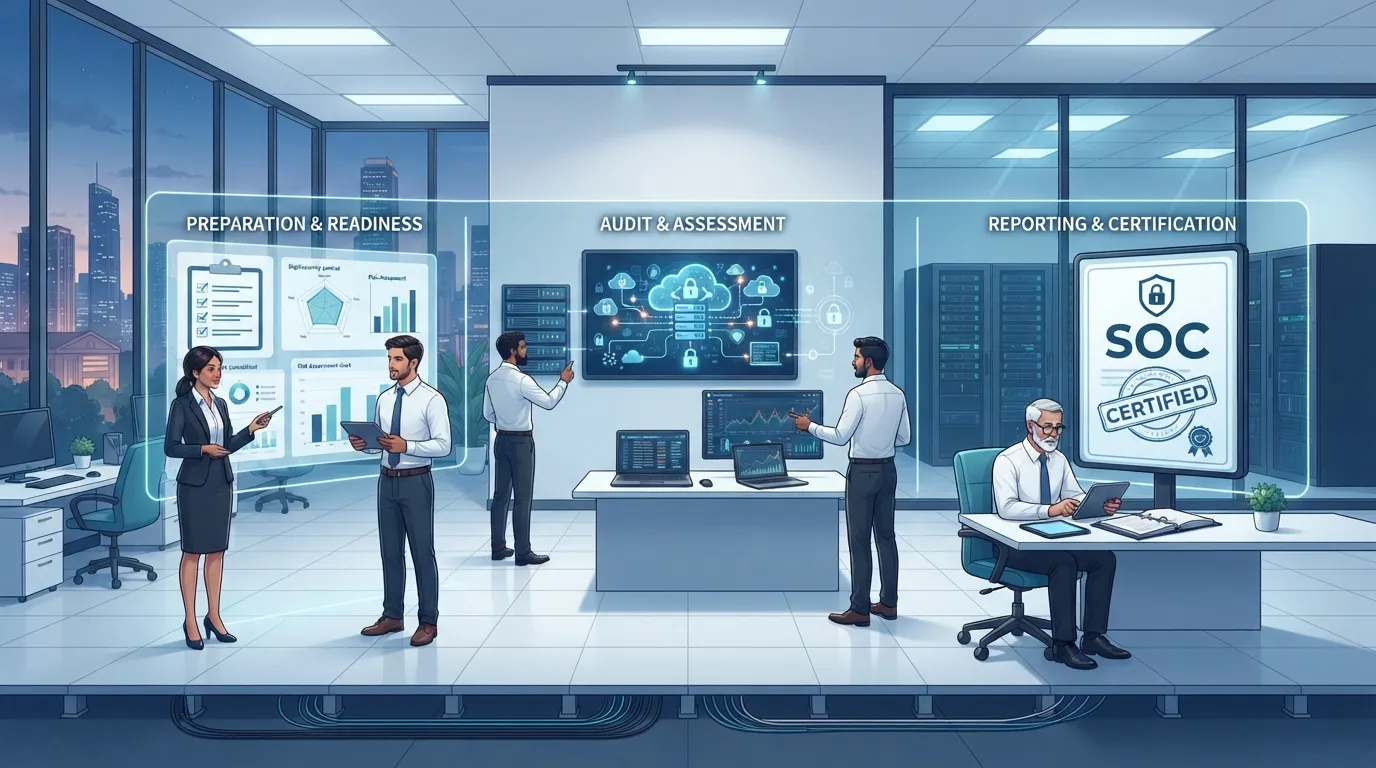
The SOC process starts with a readiness review. Next comes control setup and evidence collection. An independent audit follows. Many audits are delivered remotely in the Philippines, and we guide teams through every step.
Readiness assessment. Review current controls against the applicable SOC requirements and identify the real gaps.
Scoping. Confirm the report type, the systems and services covered, and which criteria apply beyond the mandatory ones.
Control design and implementation. Build the policies, processes and technical controls needed to close the gaps.
Evidence collection setup. Define how evidence will be captured and stored on an ongoing basis, with named owners.
Type 1 report (optional first step). A licensed CPA firm assesses whether controls are suitably designed at a point in time.
Monitoring period. For a Type 2 report, controls must operate over a defined period, commonly three to twelve months, before operating effectiveness can be tested.
Audit fieldwork. The CPA firm tests whether controls operated effectively throughout the period and requests supporting evidence.
Report issuance. The SOC report is issued and can then be shared with clients and prospects, usually under NDA.
Annual renewal. Reports cover a defined period, so most organizations repeat the cycle each year to keep a current report available.
One point worth being clear on: the SOC report itself is always issued by an independent, licensed CPA firm, not by a consulting partner. Univate Global's role is to get your organization scoped, controlled and evidence ready so the audit runs smoothly.
Timeframe for SOC Certification
SOC readiness usually takes two to four months. The timeline depends on scope, existing maturity and how quickly evidence and approvals move internally. A SOC Type 2 report also needs a monitoring period of three to twelve months before the audit can assess operating effectiveness.
| Stage | What Happens | Typical Duration |
|---|---|---|
| Readiness and gap assessment | Current state review against SOC requirements | 2 to 4 weeks |
| Control implementation | Policy, process and technical control build out | 4 to 12 weeks depending on gaps |
| Type 1 audit | Point in time design assessment by a CPA firm | Once controls are in place |
| Monitoring period (Type 2) | Controls operate and evidence accumulates | 3 to 12 months |
| Type 2 audit and reporting | Operating effectiveness testing and report issuance | Several weeks after the period closes |
We help plan timelines clearly and realistically, so commitments made to clients during procurement can actually be met.
SOC Certification Cost in the Philippines
SOC costs depend on scope, audit effort and readiness. Fees typically include both consulting support and auditor costs, which are separate items. We help control spending by focusing only on required controls and avoiding unnecessary work.
The main variables that move cost are:
- Which report is being pursued: SOC 1, SOC 2, SOC 3, or a combination
- Whether the engagement targets a Type 1 report, a Type 2 report, or Type 1 followed by Type 2
- The criteria in scope beyond mandatory Security
- Organization size, number of in scope systems, locations and headcount
- Existing maturity of controls, documentation and monitoring
- Length of the monitoring period selected for a Type 2 report
- CPA firm audit fees, which sit outside readiness and implementation consulting
- Whether a compliance automation platform is used for evidence collection
The most reliable way to understand real cost for your organization is a short discovery conversation covering scope and current maturity. We can then give you a transparent, scoped estimate.
Benefits of SOC Certification
SOC certification builds client confidence and improves internal controls. It lowers risk, supports long term contracts and reduces audit stress and vendor checks. We help organizations turn SOC into a business advantage rather than a compliance cost.
- Shorter sales cycles, since a current report answers most vendor security questions upfront
- Stronger positioning with US, UK and Australian enterprise buyers who treat SOC as a baseline
- Fewer repetitive security questionnaires, freeing up sales, IT and engineering time
- A structured, documented security program instead of controls that exist informally
- Clear internal accountability across access, monitoring, change and incident response
- Greater confidence from investors, partners and global parent organizations
- Better renewal outcomes, since existing clients can see assurance is maintained year on year
- A credible differentiator against other Philippine providers without a current report
Common Challenges in SOC Implementation
Many organizations struggle with unclear scope and missing evidence. Audit stress is also common. We simplify SOC by defining ownership early and aligning controls with daily tasks.
Over scoping adds cost and effort with no client benefit. Under scoping leaves gaps an auditor will flag. Getting this right at the start saves the most money.
Type 2 reports test the whole monitoring period. Evidence collected retroactively rarely holds up, which is why collection is built into operations from day one.
Documented procedures that nobody follows are a reliable source of audit findings. Controls need to reflect how teams actually work.
When controls are not assigned to named owners, they lapse quietly. Ownership and review cadence are defined during implementation.
Reports cover a defined period and need annual renewal. Organizations that plan for the cycle avoid repeating the same first year effort every year.
Building Internal SOC and Audit Capability
Alongside readiness work, many Philippine organizations want internal teams who can maintain the control environment between audit cycles. That usually means someone in house who understands the criteria, the evidence expectations and how auditors test controls.
Structured training on SOC 2 and related information security frameworks helps internal audit, IT and compliance teams carry the program independently. You can explore available options through our training and certification programs, or discuss a team focused format with us directly.
For organizations that need ongoing senior security leadership without a full time hire, CISO as a service is often a practical alternative.
Why Choose Univate Global for SOC Certification
Univate Solutions is a preferred management consultancy in governance, risk and compliance. We have strong experience in SOC readiness and audit support, and our approach is practical and business focused. We work closely with leadership and delivery teams to reduce audit pressure and deliver real value.
Tell us what your clients are asking for and we will tell you what it takes to get there.
Speak With Our ExpertsFrequently Asked Questions
SOC Certification in the Philippines
Is SOC certification mandatory in the Philippines?
No. SOC is a voluntary attestation framework and is not required by Philippine law. It becomes practically necessary when clients, particularly overseas enterprise buyers, make it a condition of onboarding or contract renewal.
Who can apply for SOC certification in the Philippines?
Any service organization that stores, processes or manages data or processes on behalf of its customers. In practice this covers BPO and IT-BPM providers, SaaS companies, fintech firms, healthcare outsourcing, cloud and managed IT providers, and shared services centers.
What is the difference between SOC 1, SOC 2 and SOC 3?
SOC 1 covers controls relevant to a client's financial reporting. SOC 2 covers data security and system protection against the Trust Services Criteria. SOC 3 is a public summary of SOC 2 results that can be shared openly without detailed control testing.
What is the difference between SOC 2 Type 1 and Type 2 compliance?
Type 1 assesses whether controls are suitably designed at a single point in time. Type 2 tests whether those controls actually operated effectively across a monitoring period. Most enterprise clients want to see a Type 2 report.
How long does it take to complete a SOC audit?
Readiness typically takes two to four months depending on scope and current maturity. A Type 2 report additionally requires a monitoring period of three to twelve months before the audit can test operating effectiveness.
How long is a SOC report valid?
A SOC report covers a defined period rather than carrying multi year validity. Most organizations repeat the process annually so that a current report is always available for clients and prospects.
Which industries benefit most from SOC certification?
Outsourcing and IT-BPM, SaaS and software, finance and accounting services, fintech and payments, healthcare data processing, and cloud or managed IT services see the strongest commercial return, because their clients ask for assurance most often.
What are the key requirements for SOC certification?
Clear, documented and consistently operated controls over access, change management, incident response, monitoring and governance. For SOC 2, requirements are organized under the Trust Services Criteria, with Security always in scope.
What documents are required for SOC certification?
Policies and procedures, a system description, risk assessment records, access and change logs, monitoring reports, incident records, vendor assessments and training records. The exact set depends on the SOC type and criteria in scope.
How much does SOC certification cost in the Philippines?
There is no fixed price. Cost depends on report type, scope, organization size, existing control maturity, the length of the monitoring period and the CPA firm's audit fees, which are separate from readiness consulting. A short scoping discussion produces a realistic estimate.
Is SOC certification suitable for startups and SMEs?
Yes. Smaller organizations often start with a tightly defined scope or a Type 1 report specifically to unblock an enterprise sales conversation, then move to Type 2 as the client relationship grows.
Can SOC certification be conducted remotely?
Yes. Most readiness work, including scoping, documentation and evidence collection setup, is delivered effectively through remote or hybrid engagement. Many audits in the Philippines are also conducted remotely.
Do you support SOC engagements in Makati, Manila and Quezon City?
Yes. We support organizations across Metro Manila including Makati, BGC, Ortigas and Quezon City, as well as Cebu, Clark and Davao, through on site, remote and hybrid delivery.
Who issues the SOC report?
An independent, licensed CPA firm performs the audit and issues the report. Univate Global's role is readiness, scoping, control implementation and evidence preparation ahead of that audit.
Should we pursue SOC 2 or ISO 27001 first?
It depends on where your clients are. SOC 2 is usually requested by North American buyers, while ISO 27001 is more common in European and Asian markets. Our comparison of ISO 27001 and SOC 2 sets out the differences, and many organizations eventually maintain both.
Start Your SOC Certification Journey
If a client has asked for a SOC report, or you want to be ready before that request stalls a deal, a short conversation is the fastest route to clarity on report type, scope, timeline and cost.
Univate Global supports organizations across the Philippines through every stage of SOC certification, from readiness assessment through to audit support and annual renewal.
Get a Free Consultation Call +91 72599 45454
Phone: +91 72599 45454 / +91 87923 02559
Email: info@univateglobal.com