





Contact Us
Get ISO 27001 Certification
in Philippines with the best ISO 27001 Consultant
Simple, Easy and Transparent ISO 27001 Certification Process
ISO 27001 Certification in the Philippines
A simple, transparent path to a globally recognised information security management system. Univate Global guides Philippine organisations from gap assessment through Stage 1 and Stage 2 audits with an accredited certification body.
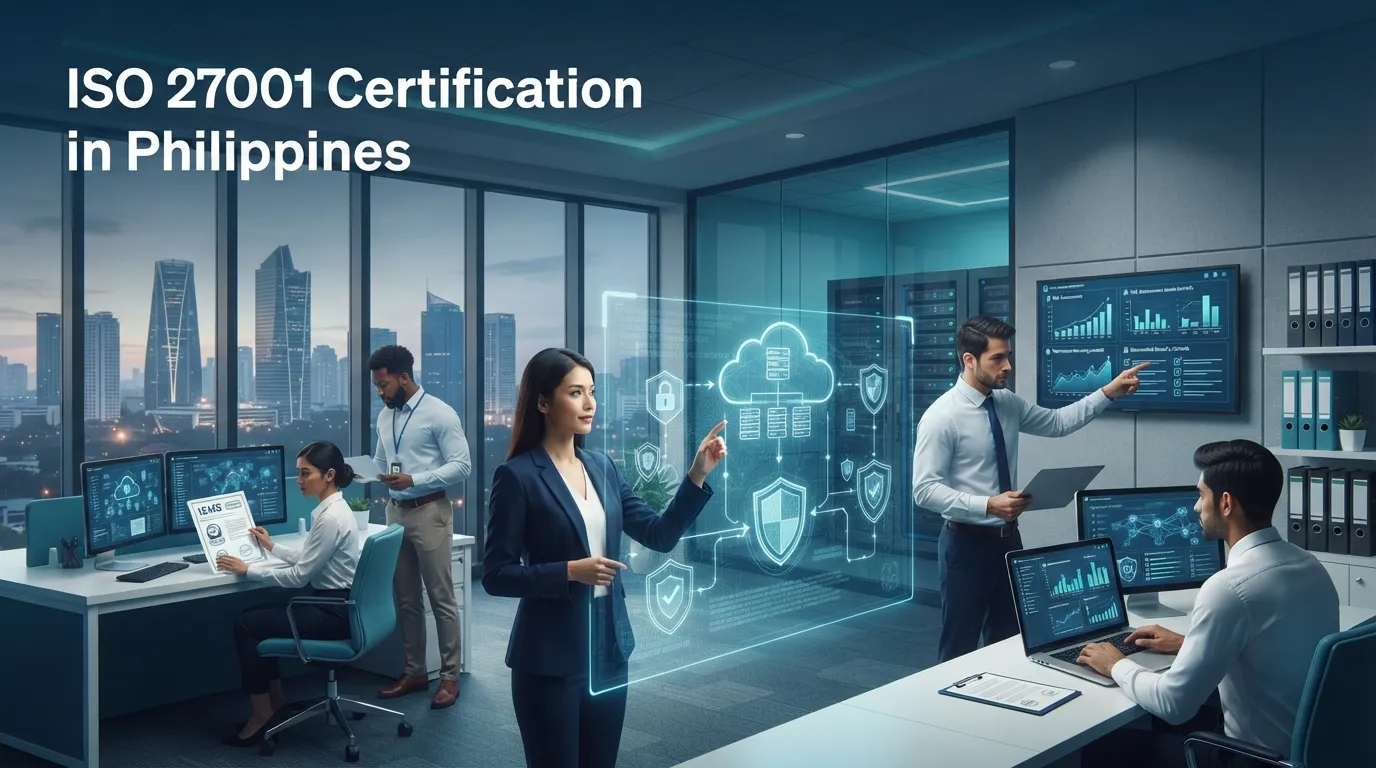
Elevate Your Business with a Globally Recognised ISMS
ISO/IEC 27001 is the international standard for an information security management system, published jointly by the International Organization for Standardization (ISO) and the International Electrotechnical Commission (IEC). The current 2022 version sets out how an organisation should manage risks to the confidentiality, integrity and availability of information, backed by 93 controls in Annex A across four themes: organisational, people, physical and technological.
In the Philippines, adoption has grown alongside the BPO and IT sectors and the enforcement of the Data Privacy Act of 2012 by the National Privacy Commission. For firms that handle client and personal data, an ISO 27001 certificate issued by an accredited certification body is a clear, internationally recognised signal that information is managed securely.
Free ConsultationWhat Is ISO 27001 and Who Publishes It?
ISO/IEC 27001 defines the requirements for establishing, operating, monitoring and continually improving an information security management system, usually shortened to ISMS. Rather than prescribing a fixed technical checklist, it asks an organisation to understand its own information risks and then select proportionate controls to treat them.
The standard has two working halves. Clauses 4 to 10 set out the management system requirements: context, leadership, planning, support, operation, performance evaluation and improvement. Annex A then provides a reference set of 93 controls that organisations select from based on their risk assessment. Our guide to what ISO 27001 covers explains the structure in more depth.
| Annex A Theme | Controls | What It Covers |
|---|---|---|
| Organisational | 37 | Policies, roles, supplier relationships, incident management, continuity, threat intelligence and cloud service use |
| People | 8 | Screening, terms of employment, awareness and training, disciplinary process, remote working |
| Physical | 14 | Secure areas, equipment security, clear desk and screen, physical monitoring, media handling |
| Technological | 34 | Access control, cryptography, logging, secure development, data leakage prevention, configuration management |
Why ISO 27001 Certification Matters for Philippine Businesses
When an organisation is certified to ISO 27001, it has shown an independent auditor that reasonable and proportionate controls are in place to protect confidential information. For Philippine businesses serving global clients, that assurance directly supports the security obligations set out in the Data Privacy Act of 2012.
By adopting ISO 27001, organisations build a risk based ISMS: they identify threats to information, select controls from Annex A, and monitor them through internal audits and management review. This structured cycle helps prevent data breaches and handle security incidents in a consistent way.
Client contracts increasingly require it
European and Asian enterprise buyers routinely name ISO 27001 in vendor onboarding, in the same way North American buyers ask for SOC 2.
The BPO and IT-BPM factor
Philippine outsourcing providers process client information under contract, which makes independent assurance a commercial requirement rather than an internal goal.
Data Privacy Act alignment
The National Privacy Commission expects reasonable organisational, physical and technical safeguards. A certified ISMS is a well recognised way to evidence them.
Fewer security questionnaires
A valid certificate and Statement of Applicability answer a large part of most vendor assessments before the questions arrive.
Structured incident handling
Certification forces documented detection, response and lessons learned, which shortens recovery time when something does go wrong.
Tender eligibility
Public and enterprise tenders in several markets treat ISO 27001 as a qualifying criterion rather than a differentiator.
Because ISO 27001 requires personal and sensitive data to be protected, certification helps maintain the trust of clients and regulators. In a market where the National Privacy Commission actively enforces data privacy, a recognised ISMS strengthens your reputation with local and international partners. For further background, see why ISO 27001 matters for Philippine businesses.
Which Organisations in the Philippines Need ISO 27001?
ISO 27001 is voluntary, but for many Philippine sectors it has become a practical condition of doing business.
| Sector | Why ISO 27001 Applies |
|---|---|
| BPO, ITeS and shared services | Client information is processed under contract, and overseas customers frequently require certification before awarding work |
| Software and SaaS companies | Enterprise buyers expect independent assurance over how product and customer data is protected |
| Fintech, banking and insurance | Sensitive financial information and regulator expectations make a formal ISMS the practical baseline |
| Healthcare providers and health data platforms | Personal health information carries heightened Data Privacy Act obligations |
| Cloud, hosting and managed IT providers | Customers building on your infrastructure need documented assurance over its security |
| Government contractors and public sector suppliers | Tender criteria increasingly list certification as a qualifying requirement |
| Logistics, e-commerce and retail platforms | Large volumes of customer personal data create both regulatory and reputational exposure |
If your organisation is repeatedly completing client security questionnaires, or a tender has listed certification as a requirement, that is usually the point at which ISO 27001 stops being optional in practice.
Key Benefits of ISO 27001 Certification for Philippine Business
Philippine organisations gain several practical benefits from ISO 27001 certification:
The standard requires controls across organisational, people, physical and technological themes, reducing the risk of unauthorised access to sensitive information.
An ISO 27001 ISMS supports the security measures expected under the Data Privacy Act of 2012 and helps demonstrate accountability to the National Privacy Commission.
Certification shows clients and partners, including the BPO sector's overseas customers, that you treat data protection seriously.
The standard is built on identifying information risks and treating them with proportionate controls, lowering the likelihood and impact of data breaches.
Certification distinguishes your business in tenders and vendor assessments. Learn more about ISO 27001 certification, its importance and benefits.
Internal audits and management review create a repeating improvement cycle, so security posture is reviewed on a schedule rather than after an incident.
Get your free consultation today.
Experience best in class support from Univate Global's ISO 27001 consultants, from gap analysis through final assessment and certification.
ISO 27001 Certification Process in the Philippines
Certification follows a defined sequence. Understanding it up front is what makes the project predictable rather than reactive.
Scoping the ISMS. Define which business units, locations, systems and information assets the management system covers, and document the boundaries.
Gap assessment. Compare current practice against the clause requirements and Annex A to establish what already exists and what is missing.
Risk assessment and treatment. Identify information risks, evaluate them against agreed criteria, and decide how each will be treated.
Statement of Applicability. Record which Annex A controls apply, which are excluded and why. This document is central to the audit.
Control implementation. Build the policies, processes and technical controls selected during treatment, from access management and cryptography to supplier and incident processes.
Awareness and training. Make sure staff understand their responsibilities, since people controls are audited alongside technical ones.
Internal audit and management review. Both are mandatory clause requirements and must be completed before the certification body arrives.
Stage 1 audit. The certification body reviews documentation and readiness, confirming the ISMS is designed correctly and that mandatory records exist.
Stage 2 audit. A deeper assessment of whether controls are implemented and operating effectively in practice, including evidence sampling and staff interviews.
Certification and surveillance. Once nonconformities are closed, the certificate is issued for a three year cycle, with annual surveillance audits and a recertification audit in year three.

Customised ISO 27001 Implementation Plans for Philippine Companies
Every organisation in the Philippines has a different risk profile, so an ISO 27001 implementation should be scoped to your business, systems and the personal data you process. A tailored approach keeps the ISMS practical and aligned with how you actually operate.
The starting point is a gap assessment and a risk assessment: you identify where information is exposed, then select and apply controls from Annex A, from access management and cryptography to supplier and incident processes, to treat those risks.
By scoping the work sensibly, Philippine firms can reach certification more efficiently and end up with a management system that genuinely improves security rather than sitting on a shelf. Scope discipline matters commercially too, since scope size is the single largest driver of both audit effort and cost.

How Long Does ISO 27001 Certification Take?
Timelines depend on scope, existing maturity and how quickly internal approvals move. A small single site organisation with documented practices already in place progresses far faster than a multi site business starting from nothing.
| Stage | What Happens | Typical Duration |
|---|---|---|
| Scoping and gap assessment | Define ISMS boundaries and assess current state against the standard | 2 to 4 weeks |
| Risk assessment and treatment planning | Identify risks, agree criteria, produce the Statement of Applicability | 3 to 6 weeks |
| Control implementation | Build policies, processes and technical controls | 2 to 6 months depending on gaps |
| Internal audit and management review | Mandatory clause requirements completed before certification audit | 2 to 4 weeks |
| Stage 1 and Stage 2 audits | Certification body assessment, usually with a gap between the two stages | 4 to 10 weeks end to end |
Once certified, the ISMS is maintained across a three year cycle with annual surveillance audits. Organisations that keep internal audit and management review running on schedule find recertification straightforward. Those that let the system lapse between audits usually repeat much of the original effort.
ISO 27001 Certification Cost in the Philippines
In the Philippines, the cost of ISO 27001 certification depends on several factors: the size of the organisation, the number of sites, the complexity of your IT infrastructure, and how mature your existing controls are. A small single site firm will typically evaluate fewer systems than a large enterprise with a complex network.
Typical cost components include the initial gap and risk assessment, implementing the selected Annex A controls, staff awareness training, and the Stage 1 and Stage 2 audits carried out by an accredited certification body. The annual surveillance audits during the three year certification cycle should also be budgeted for.
- ISMS scope, meaning the business units, locations and systems included
- Headcount and number of sites, both of which drive certification body audit day calculations
- Complexity of the IT estate, including cloud services, in house development and legacy systems
- Current maturity of policies, controls and documented evidence
- Consulting support required for gap assessment, risk assessment and implementation
- Certification body fees for Stage 1 and Stage 2, which are separate from consulting costs
- Annual surveillance audits and the year three recertification audit
- Any tooling, training or technical remediation identified during risk treatment
Certification body fees and consulting fees are quoted separately, so budget for both. Our broader guide to ISO 27001 certification cost sets out the same drivers, and a short scoping conversation will produce a realistic figure for your organisation.
Who Accredits ISO 27001 Certification in the Philippines?
There is an important distinction between the certification body that audits you and the accreditation body that oversees the certification body. Certificates carry weight with clients only when the certification body is properly accredited.
Independent organisations that carry out the Stage 1 and Stage 2 audits and issue the certificate. Philippine organisations may work with locally based bodies or with international bodies operating in the market.
Bodies that assess and authorise certification bodies. In the Philippines this role sits with the Philippine Accreditation Bureau under the Department of Trade and Industry. Many certification bodies operating locally are accredited by overseas bodies instead.
Through international mutual recognition arrangements, an accredited certificate is accepted across markets. An unaccredited certificate may be rejected during a client's due diligence, which defeats the point of certifying.
An accredited certification body cannot also consult on the ISMS it audits. This is why implementation support and certification always come from different organisations.
Before signing with any certification body, confirm its accreditation status and that its scope covers ISO/IEC 27001. We help clients evaluate that during selection.
Meeting Philippine Compliance Standards with ISO 27001
Organisations in the Philippines that process personal data fall under the Data Privacy Act of 2012 (Republic Act No. 10173), which is administered by the National Privacy Commission. The law requires reasonable organisational, physical and technical measures to protect personal information.
While ISO 27001 certification is not itself a legal requirement, an accredited ISMS is a well recognised way to evidence those safeguards, support breach management, and show accountability to the National Privacy Commission and to your clients.
For BPO, IT and fintech providers serving overseas customers, aligning the ISMS with both the Data Privacy Act and client contractual requirements keeps the business compliant and competitive in international markets. Organisations with significant personal data processing often extend the ISMS with ISO 27701 privacy information management, which builds directly on ISO 27001 rather than duplicating it.
ISO 27001, SOC 2 and PCI DSS: Which Applies to You?
Philippine organisations are often asked for more than one of these, usually by different clients in different markets. They overlap, but they are not interchangeable.
| ISO 27001 | SOC 2 | PCI DSS | |
|---|---|---|---|
| What it is | A certifiable information security management system standard | An attestation report on controls, issued by a CPA firm | A prescriptive standard for protecting payment card data |
| Typically requested by | European, Asian and increasingly global enterprise buyers | North American enterprise buyers | Acquiring banks and card brands |
| Output | A certificate valid for three years with annual surveillance | A report covering a defined period, usually refreshed annually | An Attestation of Compliance, renewed annually |
| Nature | Risk based, with controls selected from Annex A | Criteria based, with scope selected from the Trust Services Criteria | Prescriptive, with 12 defined requirements |
Many organisations end up maintaining more than one. Where that happens, the control work can be planned together to avoid duplicating effort. See our comparisons of ISO 27001 and SOC 2 and ISO 27001 and the NIST Cybersecurity Framework, or read about SOC certification and PCI DSS certification in the Philippines.
Common Challenges in ISO 27001 Implementation
Most delayed certifications trace back to the same handful of issues, all of which can be avoided with the right groundwork.
Scope defined too broadly
Including every system and site from the outset multiplies audit days and implementation effort. A defensible, well argued scope is usually the better start.
Risk assessment treated as paperwork
A risk register produced to satisfy the auditor rather than to drive control selection tends to unravel under Stage 2 questioning.
Policies that do not match practice
Auditors interview staff. Documented procedures that nobody follows are one of the most common sources of nonconformities.
Internal audit skipped or rushed
Internal audit and management review are mandatory clause requirements. Missing evidence of either will stop a Stage 2 audit.
Weak supplier controls
Cloud services and subcontractors sit within scope. Undocumented third party arrangements are a frequent finding for BPO organisations.
Letting the ISMS lapse after certification
Surveillance audits check that the system is still running. Organisations that stop after the certificate arrives face difficulties in year two.
ISO 27001 Consulting Across the Philippines
Demand concentrates in the country's main business and outsourcing districts, and engagements can be delivered on site, remotely or as a hybrid.
Makati
Financial services, professional firms and shared services operations in the central business district, where client assurance requirements are highest.
Metro Manila including BGC and Ortigas
Technology companies, banks and large outsourcing operations across the capital region.
Quezon City
A dense cluster of BPO campuses and IT centres where certification is increasingly written into client contracts.
Cebu, Clark and Davao
Growing delivery locations expected to meet the same information security standards as Manila based operations.
To help us better address your ISO 27001 requirements, tell us about your scope, your sites and the clients asking for certification.
Get in TouchUnivate Global: Trusted Partner for ISO 27001 Certification in the Philippines
Achieving ISO 27001 can be demanding, so it helps to work with consultants who understand both the standard's requirements and the Philippine regulatory and business context. Univate Solutions is a preferred management consultancy in governance, risk and compliance.
Businesses across the Philippines seeking certification work with us. We support organisations of every size, from BPO and IT firms to fintech and healthcare providers, through the full journey: gap assessment, risk assessment, control implementation, and the Stage 1 and Stage 2 certification audits with an accredited certification body.
With the right support, the path to certification is more predictable, and you finish with an ISMS that is maintained through the annual surveillance audits rather than treated as a one off exercise. Where ongoing security leadership is needed without a full time hire, CISO as a service is a practical option.
Our Clients







Client Testimonials
It was really a great partnership with their team.
Sultan
I had the pleasure and opportunity of working with Univate Solutions on a couple of High Maturity (ML5) CMMI appraisals and found them to be one of the best.
Amulya P
Team Univate holds many professional approaches.
Ashish Sherlekar
Common FAQs on ISO 27001 Certification in the Philippines
What is ISO 27001 and who publishes it?
ISO/IEC 27001 is the international standard for an information security management system. It is published jointly by the International Organization for Standardization and the International Electrotechnical Commission. The current version is ISO/IEC 27001:2022, which sets out the requirements for establishing, operating and continually improving an ISMS, supported by 93 controls in Annex A across four themes: organisational, people, physical and technological.
Who accredits ISO 27001 certification in the Philippines?
Certificates are issued by certification bodies, which are themselves accredited by an accreditation body. In the Philippines the national accreditation body is the Philippine Accreditation Bureau under the Department of Trade and Industry, and many certification bodies operating locally are accredited by overseas bodies instead. Through international mutual recognition arrangements an accredited certificate is accepted across markets, so always confirm a certification body's accreditation status before signing.
Is ISO 27001 mandatory in the Philippines, and how does it relate to the Data Privacy Act?
ISO 27001 is voluntary and is not required by Philippine law. The Data Privacy Act of 2012 (Republic Act No. 10173) does require reasonable organisational, physical and technical safeguards for personal data, and a certified ISMS is a widely recognised way to evidence those safeguards to the National Privacy Commission and to clients. In practice, certification often becomes a commercial requirement through client contracts and tenders.
Which organisations in the Philippines typically need ISO 27001?
BPO and IT-BPM providers, software and SaaS companies, fintech and financial services firms, healthcare and health data platforms, cloud and managed IT providers, and organisations bidding for public sector or enterprise contracts. Broadly, any organisation handling client or personal information where a buyer expects independent assurance.
What does the ISO 27001 certification process involve?
Scoping the ISMS, a gap assessment, a risk assessment and treatment plan, the Statement of Applicability, control implementation, awareness training, then mandatory internal audit and management review. The certification body then conducts a Stage 1 documentation and readiness review followed by a Stage 2 assessment of whether controls operate effectively. The certificate runs for three years with annual surveillance audits.
How long does ISO 27001 certification take and what drives the cost?
Most organisations plan for several months from scoping to Stage 2, with control implementation being the longest and most variable phase. Cost is driven by ISMS scope, headcount and number of sites, IT complexity, current control maturity, consulting support and certification body audit fees, plus annual surveillance audits across the three year cycle.
What is the difference between ISO 27001 and ISO 27002?
ISO 27001 is the certifiable standard containing the management system requirements and the Annex A control set. ISO 27002 is guidance that explains how to implement those controls in practice. You certify against ISO 27001; you use ISO 27002 as a reference while implementing.
Do we still need to transition from ISO 27001:2013?
The transition period for the 2013 edition closed on 31 October 2025, so certificates issued against ISO/IEC 27001:2013 are no longer valid. Any organisation certifying or recertifying now works to ISO/IEC 27001:2022, including the 2024 amendment that added climate change to the organisational context requirements.
Should we pursue ISO 27001 or SOC 2 first?
It depends on where your clients are. ISO 27001 is more commonly requested by European and Asian buyers, while SOC 2 is the North American default. Many Philippine organisations serving both markets maintain both, in which case the control work can be planned together. Our comparison of ISO 27001 and SOC 2 covers the differences.
Can a consultancy also issue our certificate?
No. Accreditation rules require independence, so an accredited certification body cannot consult on the ISMS it audits. Univate Global provides implementation and audit readiness support, and the certificate is issued separately by an accredited certification body.
Can ISO 27001 work be delivered remotely?
Yes. Scoping, risk assessment, documentation and audit preparation are delivered effectively through remote or hybrid engagement. Certification bodies set their own policies on remote versus on site auditing, which is worth confirming during selection.
What happens if we fail the Stage 2 audit?
Failing outright is uncommon when readiness work has been done properly. Auditors usually raise nonconformities, classified as minor or major, with a defined window to correct them. Once corrective actions are accepted, the certificate is issued. Thorough internal audit beforehand is the most reliable way to avoid major findings.
If you have more questions regarding ISO 27001 certification in the Philippines, get in touch with our experts today or email info@univateglobal.com for more information.
Start Your ISO 27001 Certification Journey
Whether a client has asked for certification, a tender has listed it as a requirement, or you simply want to know how large your ISMS scope needs to be, a short conversation is the fastest way to get clarity on scope, timeline and cost.
Univate Global supports organisations across the Philippines through every stage of ISO 27001 certification, from gap assessment to Stage 2 and through the annual surveillance cycle.
Get a Free Consultation Call +91 72599 45454
Phone: +91 72599 45454 / +91 87923 02559
Email: info@univateglobal.com