





Occupational Health and Safety | ISO 45001 Quezon City
ISO 45001 Certification in Quezon City: A Practical Guide for Construction and Manufacturing

Quezon City is building. Residential towers rise along its corridors, industrial zones in Novaliches, Balintawak and Bagbag keep producing, and infrastructure work threads through nearly every district. All of that activity is carried by workers in some of the most hazard-dense environments in any economy, which is exactly why ISO 45001 certification in Quezon City has become a serious agenda item for the construction and manufacturing firms operating there. It is the international standard for occupational health and safety management, and increasingly, it is also the credential that principals, developers and multinational buyers ask to see before awarding work.
This guide explains what the standard requires, how it fits with Philippine safety law, what implementation involves on a real site or factory floor, how certification proceeds for a contractor or manufacturer, and why firms that implement it properly see returns far beyond the audit certificate. It is written for the people who carry the consequences: owners signing prequalification documents, project managers answering for schedules, plant managers balancing output and safety, and safety officers trying to turn policies into daily practice. If you would rather talk through your own situation, our Quezon City consultants can help.
Table of Contents
- What ISO 45001 Is and Why It Replaced OHSAS 18001
- Who in Quezon City Needs It
- The Local Context: DOLE Rules and Client Expectations
- What Implementation Involves on a Real Site
- Implementing It on a Construction Project vs a Factory
- Worker Participation in Practice
- Measuring Safety Performance
- Certification, Timeline and Cost
- What Changes After Certification
- Keys to a Certification Project That Sticks
- Integrating with Quality and Environmental Standards
- How Univate Supports the Journey
- Final Thoughts
- Frequently Asked Questions
What ISO 45001 Is and Why It Replaced OHSAS 18001
ISO 45001 is the global standard for occupational health and safety management systems, usually shortened to OHSMS. It superseded the older OHSAS 18001 and brought safety management into the same high-level structure as ISO 9001 and ISO 14001, which means it integrates cleanly with quality and environmental systems a company may already run. The core idea is prevention through management: hazards are identified before they hurt someone, risks are assessed and controlled in a deliberate order, workers participate in the system rather than merely comply with it, and leadership owns the results.
Two emphases distinguish it from older approaches. The first is top management accountability. The standard explicitly requires leadership to take ownership of safety outcomes, ensure resources, protect workers from reprisal when they report incidents or hazards, and promote a positive safety culture, rather than delegating everything downward to a safety officer. The second is worker participation. Consultation with non-managerial workers on hazards, incidents, controls, training needs and objectives is a requirement, not a courtesy, and auditors verify it by talking to people on the floor and on the scaffold, not just in the boardroom.
The standard also takes a broad view of health. It covers injuries, but also occupational illness and, where relevant, psychosocial risks such as fatigue, excessive working hours, harassment and work-related stress. Heat stress on outdoor work, noise and dust exposure in plants, ergonomic strain on assembly lines and fatigue on long shifts all belong inside a modern OHSMS where they genuinely apply.
Who in Quezon City Needs It
Although this guide focuses on construction and manufacturing, the standard is not limited to them. Logistics and warehousing operators, utilities, facilities management firms, security agencies, hospitals and even large office-based employers in Quezon City certify as well, because every workplace has hazards.
Construction firms face the most immediate pressure. Developers and main contractors increasingly prequalify subcontractors on safety performance and documented systems, and international project owners often expect certification outright. Contractors working across the capital and the Visayas often need one system that covers projects in Quezon City, Manila and Cebu alike. Manufacturers feel the pull from export buyers and multinational customers who audit supplier factories against social compliance, environmental and safety requirements. Service companies with large field workforces, such as facilities maintenance or logistics, feel it from enterprise clients who now carry their own safety obligations into their supply chains.
The Local Context: DOLE Rules and Client Expectations
Philippine employers already carry legal duties under Republic Act 11058, which strengthens compliance with occupational safety and health standards, and its implementing rules and the Department of Labor and Employment's occupational safety and health standards. These cover requirements such as safety officers, safety and health committees, training, personal protective equipment, construction safety programs, incident reporting and penalties for violations. Construction projects in particular need approved construction safety and health programs.
ISO 45001 does not replace any of that. What it adds is the management system that keeps those obligations running consistently: documented, measured, audited and improved, instead of depending on the diligence of one safety officer or the anxiety that precedes an inspection. Evaluation of compliance with legal requirements is itself a requirement of the standard, so a certified system gives you a structured way to confirm that DOLE obligations are met and recorded.
Commercially, the pull comes from clients. Developers, principals and multinational project owners increasingly screen contractors on safety performance, asking for incident statistics, safety management plans and certifications during prequalification. A certified OHSMS answers those questions with third-party evidence, and on international projects it is often simply expected. For manufacturers, buyers auditing their supply chains ask the same questions about factory conditions, and the certificate serves the same role.
What Implementation Involves on a Real Site
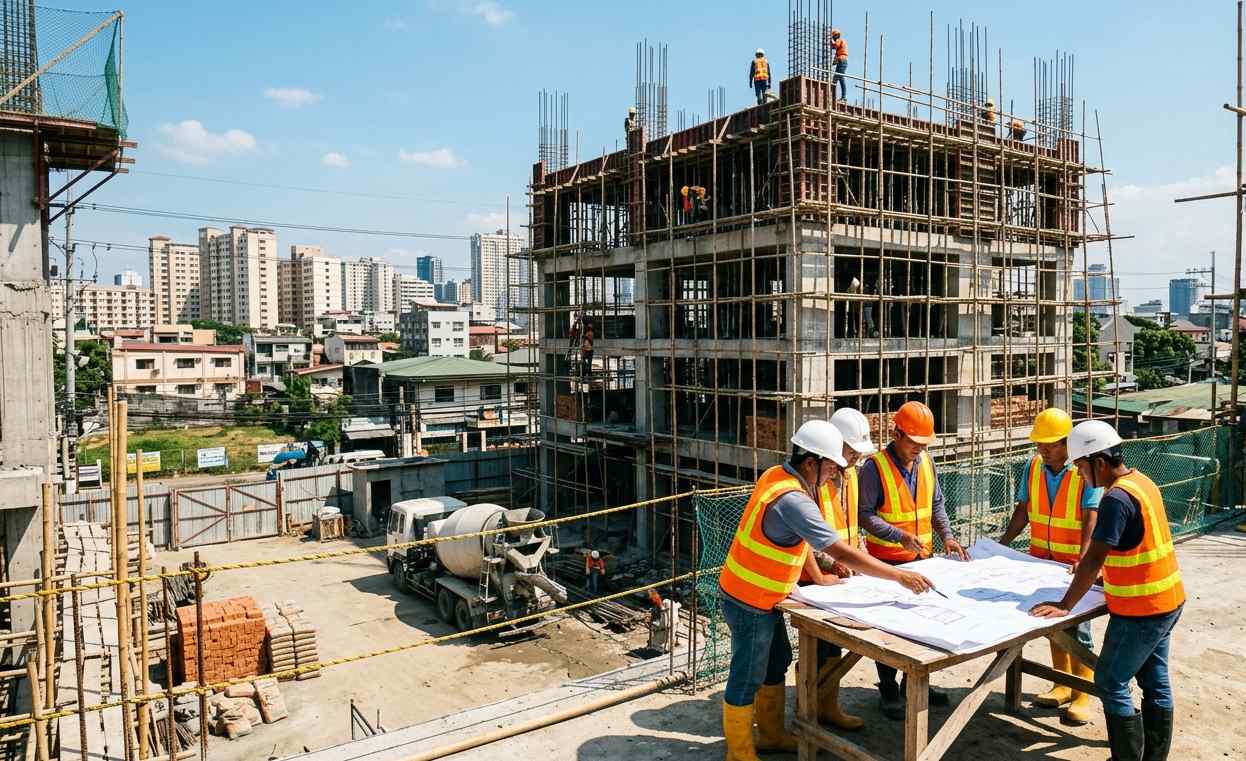
The journey begins with hazard identification and risk assessment across your actual operations, from excavation, work at height, lifting operations, confined spaces and temporary electrical work on construction sites to machine guarding, chemical handling, forklift traffic, noise and ergonomics in plants. Routine and non-routine activities both count, as do activities of contractors and visitors, and the effects of the work environment on people.
Each significant risk receives controls chosen along the hierarchy of controls: eliminate the hazard where possible; substitute with something less hazardous; apply engineering controls such as guards, barriers and ventilation; add administrative controls such as permits, procedures, training and supervision; and finally rely on personal protective equipment. The discipline of that order matters, because a system that reaches for PPE first is treating symptoms while the hazard remains.
Around that core, the system takes shape: a safety policy and measurable objectives; legal compliance evaluation against DOLE requirements; operational controls and permits to work for high-risk activities; management of change, so new equipment, materials or methods are assessed before use; procurement and contractor controls, so subcontractors meet your standards; emergency preparedness that reflects real scenarios including fire, structural failure, chemical release, earthquakes and typhoons; incident investigation that finds root causes rather than culprits; and internal audits with management review closing the loop. Many firms strengthen the emergency side further with a formal business continuity program.
Documentation is kept proportionate. A 60-person contractor does not need a conglomerate's manual. It needs procedures its supervisors actually use at the morning toolbox talk, risk assessments its crews have actually read and permits its foremen actually issue.
Implementing It on a Construction Project vs a Factory
The standard is the same, but the reality differs, and planning for those differences avoids frustration.
| Aspect | Construction projects | Manufacturing plants |
|---|---|---|
| Workplace | Changes constantly as the project progresses | Relatively stable layout and processes |
| Workforce | Many subcontractors and short-term workers | Mostly permanent employees, some contractors |
| Key hazards | Work at height, excavation, lifting, falling objects | Machinery, chemicals, noise, forklifts, ergonomics |
| Risk assessment | Repeated per project and per stage | Maintained per process and reviewed on change |
| Main challenge | Bringing subcontractors into one system | Sustaining discipline in routine work |
| Audit approach | Head office plus live project sites | Plant floor, maintenance and storage areas |
For contractors, the head office system has to travel to every site, adapted to each project's hazards and subcontractor mix. Project safety plans, site inductions, daily toolbox talks and subcontractor prequalification become the mechanisms through which the system reaches the people actually doing the work. For manufacturers, the challenge is sustaining discipline in routine operations where familiarity breeds shortcuts, so supervision, preventive maintenance, lockout and tagout, and regular inspections carry most of the weight.

Worker Participation in Practice
Worker participation is the requirement companies most often underestimate, and the one auditors test most directly. It means more than a safety committee that meets because DOLE requires it. It means non-managerial workers are genuinely consulted on how hazards are identified, which controls are chosen, what training is needed and how incidents are investigated, and that they participate in decisions where they have the knowledge to contribute.
On a construction site, participation might look like crew leaders reviewing the method statement for a lifting operation before it starts, workers raising hazards during the daily toolbox talk with those concerns logged and acted on, and a simple way to report near misses without fear of being blamed. In a factory, it might look like operators contributing to machine risk assessments, joining incident investigations on their own line, and seeing visible follow-up on the issues they report. The standard also requires removing obstacles to participation, such as language barriers, fear of reprisal or lack of time, which matters in workplaces with many short-term or contractual workers.
When auditors interview a mason or a machine operator and hear that they know how to stop unsafe work, have reported a hazard and seen it fixed, and understand the controls on their own task, they see a living system. When they hear silence, they see a paper one.
Measuring Safety Performance
A management system needs measures, and safety measures come in two kinds. Lagging indicators record what has already gone wrong: lost-time injuries, recordable incidents, occupational illnesses and days lost. They matter, but they arrive too late to prevent harm, and on a well-run site they may be so low that they reveal little.
Leading indicators record the activities that prevent harm: inspections completed, near misses reported and closed, toolbox talks held, training completed before work starts, permits issued correctly, corrective actions closed on time and subcontractor prequalifications performed. A rising number of reported near misses is often a healthy sign, because it shows workers trust the reporting system. Objectives built on leading indicators give management something to act on before an injury happens, and they give auditors evidence that the system is working rather than simply lucky.
Food and beverage manufacturers in Quezon City often measure safety alongside food safety performance, and many run their OHSMS together with ISO 22000 so hygiene, equipment and worker safety are managed in one framework.
Certification, Timeline and Cost
Certification follows the familiar two-stage pattern with an accredited certification body: a Stage 1 review of your documentation and readiness, then a Stage 2 audit that tests how the system works in practice, including site visits and worker interviews. The certificate remains valid for three years with annual surveillance audits. Most mid-sized firms reach the certification audit in four to six months, with multi-site contractors planning longer because auditors will want to see live project sites, not just the head office.
On cost, the honest answer mirrors every management system standard: there is no fixed price. The consulting effort and the certification body's audit days scale with headcount, the number of sites and projects in scope, the severity of the hazard profile and how much of a working safety program already exists. A manufacturer with disciplined DOLE compliance and good records starts much further along than a contractor formalizing safety for the first time, and the gap analysis at the start of the project is what turns that difference into a concrete budget. Choose a certification body accredited by the Philippine Accreditation Bureau or another International Accreditation Forum member, since clients check.
What Changes After Certification
The shift is easiest to see area by area. Hazard management moves from reactive, incident-driven fixes to systematic identification with risk-ranked controls. Legal compliance stops being something checked when an inspection looms and becomes a scheduled evaluation with records kept. Incident investigation moves away from finding someone to blame and toward root causes with tracked corrective actions. Worker involvement changes from instructions flowing one way to consultation and reporting channels that actually function. Subcontractors move from informal management to prequalification, induction and monitoring. And in client prequalification, a safety record that used to be argued case by case becomes a certified system presented as standing evidence.
The financial side follows the operational side. Fewer incidents mean fewer work stoppages, fewer medical and compensation costs, less schedule disruption, fewer penalties and fewer disputes. Insurers and clients both read a certified system as lower risk, and on long projects the compounding effect of uninterrupted work is substantial. None of this requires believing in paperwork for its own sake. It requires believing that predictable operations are cheaper than emergencies, which every project manager already knows.
Keys to a Certification Project That Sticks
What separates lasting systems from wall certificates:
- A named senior sponsor who owns safety outcomes, not just a safety officer who owns forms
- Risk assessments written with the crews who face the hazards, in language they use
- Controls chosen up the hierarchy, with PPE as the last layer rather than the first
- Toolbox talks and consultation channels that feed real issues back into the system
- Incident and near-miss reporting treated as information, never as grounds for blame
- Subcontractors brought inside the system, since their incidents happen on your site
- Internal audits scheduled on live projects and plant floors, not only at the head office
Integrating with Quality and Environmental Standards
Because ISO 45001 shares its structure with ISO 9001, firms that already hold a quality certificate can add safety to existing document control, audit and review machinery instead of duplicating it. Many Quezon City contractors pursue both together, presenting clients with an integrated management system, and our ISO 9001 service is commonly delivered in exactly that pairing. Our article on how quality management wins contracts explains the commercial side of that combination. Firms with environmental obligations, such as dust, waste, wastewater and emissions on construction sites or in plants, often add ISO 14001 to complete the trio. Organizations that want a stronger enterprise approach to hazards and business risks sometimes align with ISO 31000 risk management principles as well.
How Univate Supports the Journey
Univate Global consults on the full path through our Quezon City ISO 45001 service: hazard and risk workshops on your sites, documentation built around your actual operations, legal compliance mapping against DOLE requirements, subcontractor management, internal audits and preparation for both certification stages. The same program runs across the capital through our Manila team, in the Visayas through our Cebu team, and for firms with projects around the country through our nationwide ISO 45001 practice. As always, we prepare you for the audit while an independent accredited body performs it, which is what keeps the certificate credible. Companies that already hold a quality certificate in the capital often extend it with safety through our Manila ISO 9001 team at the same time, and you can see the organizations we support on our clients page. You can explore all of our Philippine services or contact us for a free consultation.
Final Thoughts
For construction and manufacturing firms in Quezon City, ISO 45001 sits at the intersection of three pressures: legal duties that already exist, clients that increasingly demand proof, and the plain operational truth that incidents are the most expensive way to learn. A properly built OHSMS answers all three at once. The certificate gets you through prequalification. The system behind it is what sends every worker home intact and keeps every project moving, and that is the return that outlasts any audit cycle.
Frequently Asked Questions
Is ISO 45001 mandatory in the Philippines?
No. Legal safety duties come from RA 11058 and DOLE standards, which apply regardless of certification. ISO 45001 is voluntary, but clients and principals increasingly require it during contractor and supplier prequalification, which makes it commercially important.
How long does ISO 45001 certification take?
Most mid-sized firms reach the certification audit in four to six months. Contractors with multiple active sites should plan longer, since auditors need to observe controls working on live projects, not just review documents at the head office.
Does ISO 45001 replace our DOLE compliance obligations?
No. DOLE requirements remain fully in force. The standard provides the management system that keeps those obligations consistently met and documented, and evaluation of legal compliance is itself one of its requirements.
Can a small contractor get certified?
Yes. The system scales to the organization, and a smaller firm has a simpler scope and shorter audit. What matters is that the documented system matches real site practice, whatever the company's size.
Do subcontractors fall under our ISO 45001 system?
Work performed under your control falls within your system, so subcontractor activities on your sites must be covered by your hazard assessments, inductions and operational controls. Auditors routinely examine how subcontracted work is managed.
Can ISO 45001 be combined with ISO 9001 and ISO 14001?
Yes, and it usually should be. The standards share the same structure, so policies, document control, internal audits and management reviews can run as one integrated system with combined external audits.
What is the difference between ISO 45001 and OHSAS 18001?
ISO 45001 replaced OHSAS 18001. It adopts the common management system structure, places stronger emphasis on leadership accountability and worker participation, and takes a broader view of risks and opportunities. OHSAS 18001 certificates are no longer issued.
Do auditors visit our construction sites?
Yes. For contractors, auditors typically visit the head office and a sample of active project sites to confirm that hazard controls, inductions, permits and supervision work in practice. The number of sites sampled depends on the scope and size of the operation.