





ISO 31000 Risk Management certification in India
In today’s fast-paced business environment, risk management has become a substantial part of organizations. For Indian organizations, ISO provides a practical and well-furnished framework that helps in assessing and managing risks. It structurally supports organizations of all sizes and complexity to mitigate operational issues and improve decisions. This framework strengthens resilience and protects long-term values.
Univate plays a vital role by offering expert consulting to firms worldwide. It provides appraisal support and its end-to-end implementation services to limit risk exposures. All these real-world implementations help firms meet real business goals. In this article, we will be discussing all the core principles of ISO 31000 and how to implement them.
What is ISO 31000?
ISO 31000 is an international risk management framework. Businesses implementing this module benefit from identifying, analyzing, and managing risks in a structured manner. In business terms, it is a practical system to make smarter decisions under uncertainty. It is not a certification but a set of best-practice guidelines that any organization can implement.
ISO 31000 boosts profitability by reducing losses and avoiding operational disruptions. It also helps businesses spot risks early, protect revenue, and make confident investment decisions. In simple terms, this framework is a decision-support system made for businesses to turn risk management from a cost center into a strategic tool.

Applicability of ISO 31000 in India
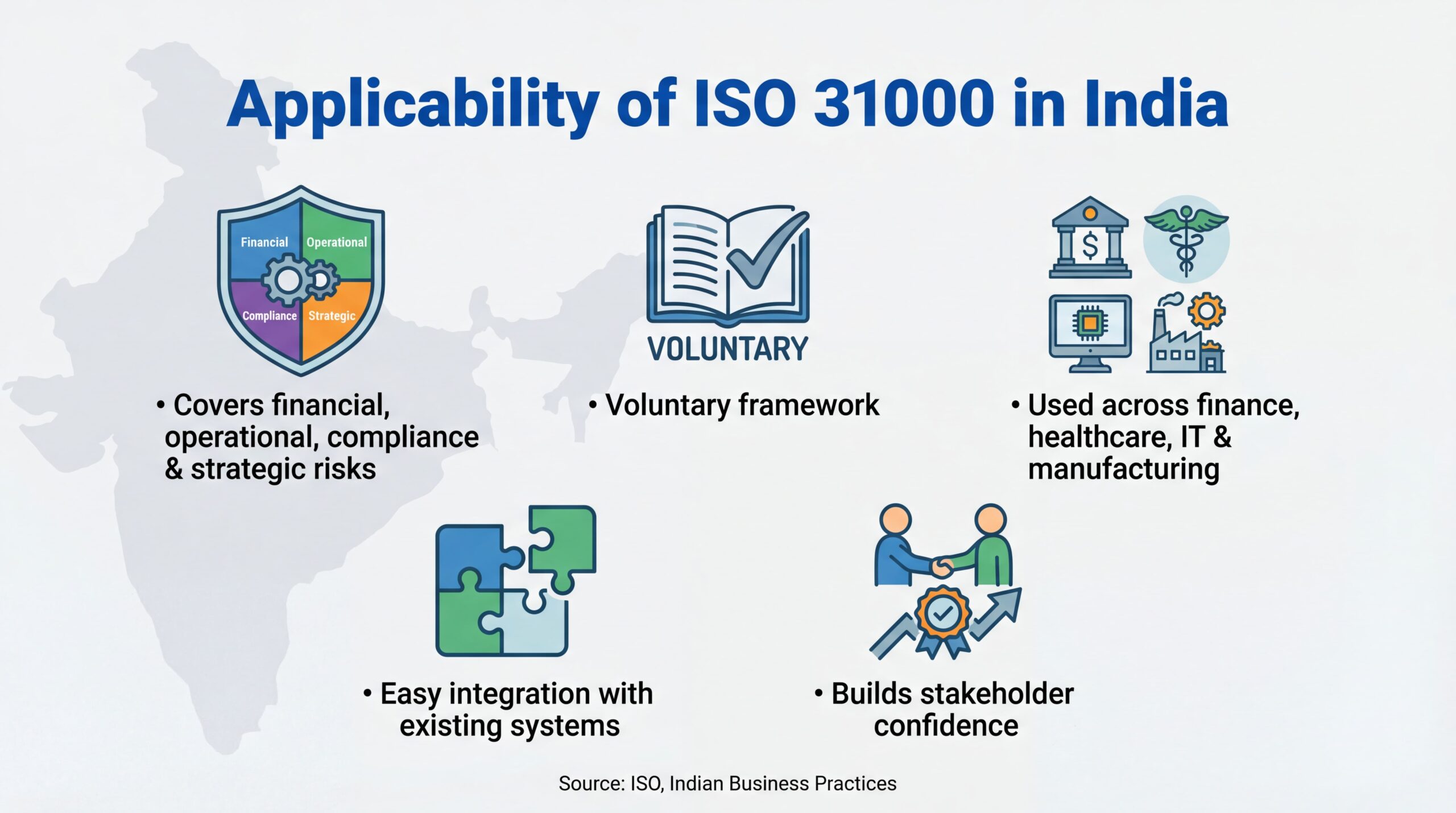
- Broad use: It covers systematic, financial, operational, and compliance risks across projects, products, and processes.
- Voluntary framework: It is not a certification. But organizations can show alignment to demonstrate strong risk practices.
- Key industries in India: Widely used in finance, healthcare, IT, and manufacturing to improve control and security
- Business benefits: It helps reduce disruptions, protect reputation, and build stakeholder confidence.
- Easy integration: We can use it with existing management systems for a consistent, organization-wide risk approach.
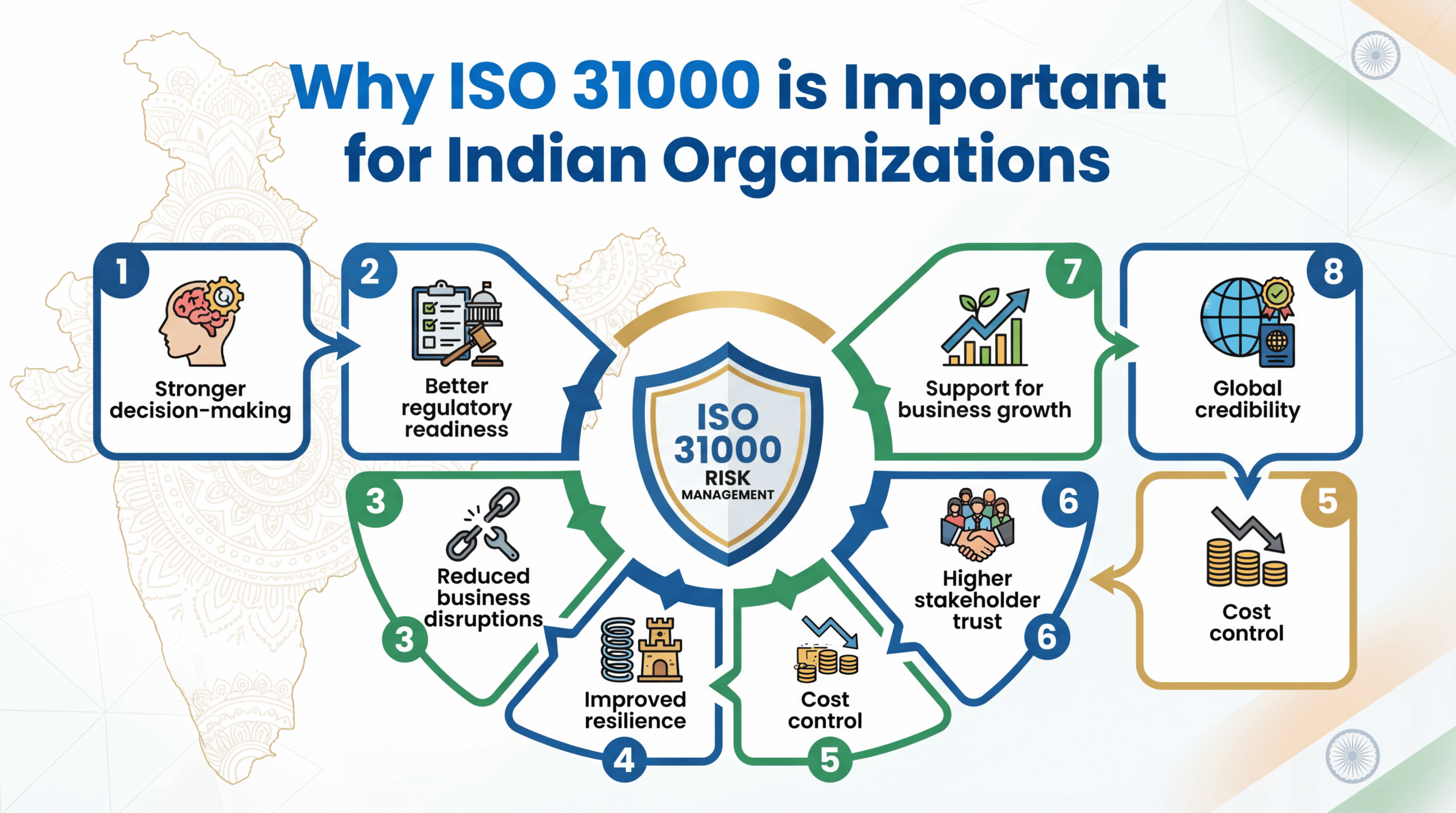
Importance of ISO 31000 in Indian organizations

Stronger decision-making
It helps businesses make informed choices in uncertain business conditions.

Better regulatory readiness
It supports compliance with complex Indian laws and regulations.
Reduced business disruptions
The Indian companies can identify risks early to prevent operational losses.
Improved business resilience
It helps in preparing Indian firms for market, supply chain, and economic changes.

Cost control
It reduces financial losses and improves the use of resources.
Higher stakeholder trust
It helps in building trust and confidence with investors, customers, and partners.

Support for business growth
It helps in managing risks linked to expansion and new markets.
Alignment with global standards
This improves credibility with international clients and partners.
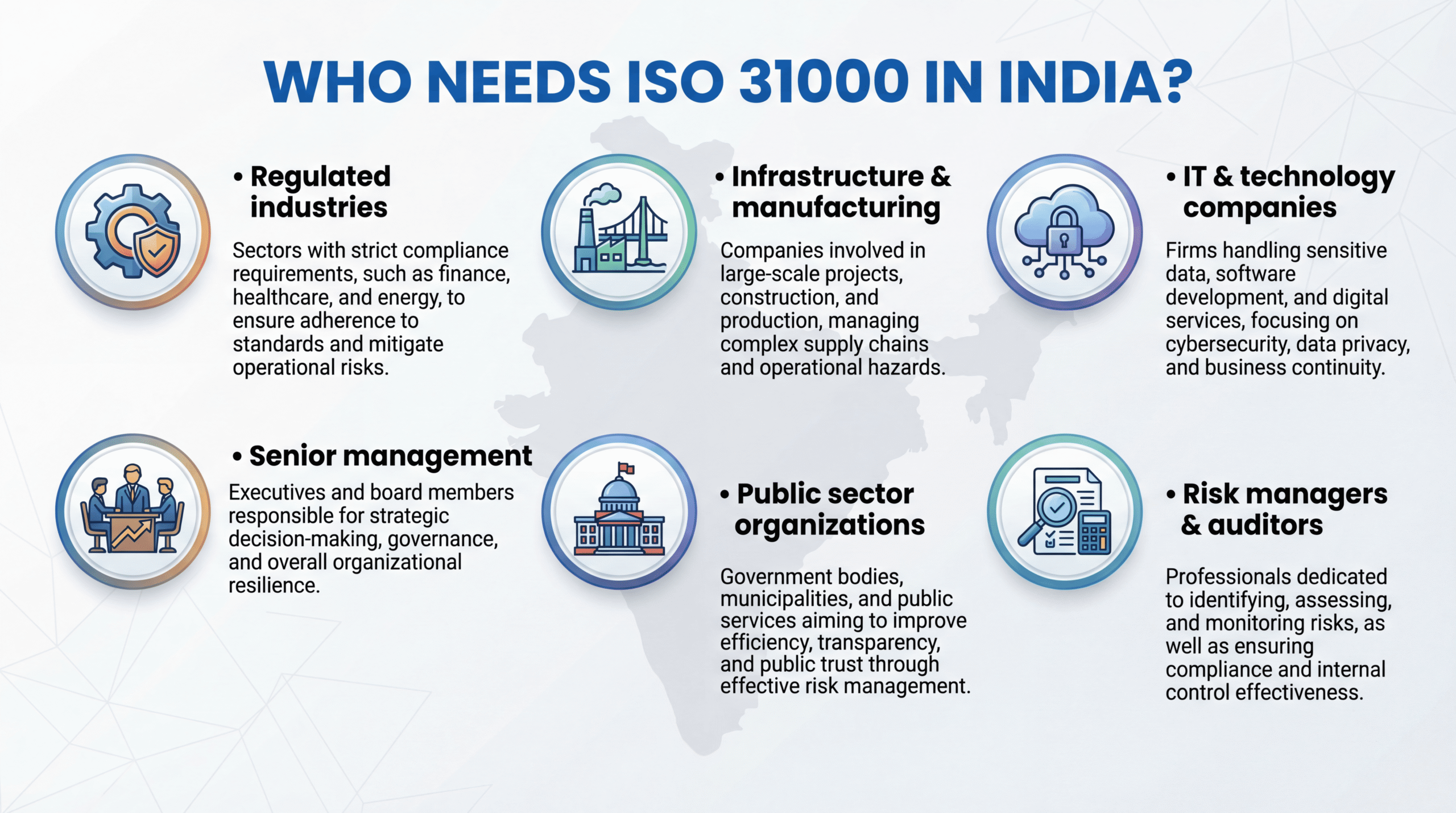
Who Needs ISO 31000 in India?
Indian oorganizations (private, public, government, or non-profit) that need ISO 31000 can be the following, as listed:
- Heavily Regulated Sectors
- Infrastructure & Manufacturing
- IT & Technology Companies
- Senior Management & Decision Makers
- Public Sector Organizations
- Risk Managers & Auditors
Benefits of the ISO 31000 risk management framework
It helps organizations handle disruptions and adapt to change.
It reduces losses by addressing risks early and using resources wisely.
It builds confidence through clear and consistent risk practices.
It encourages early risk identification instead of reactive problem-solving.
We can better meet legal and contractual risk requirements using this framework.
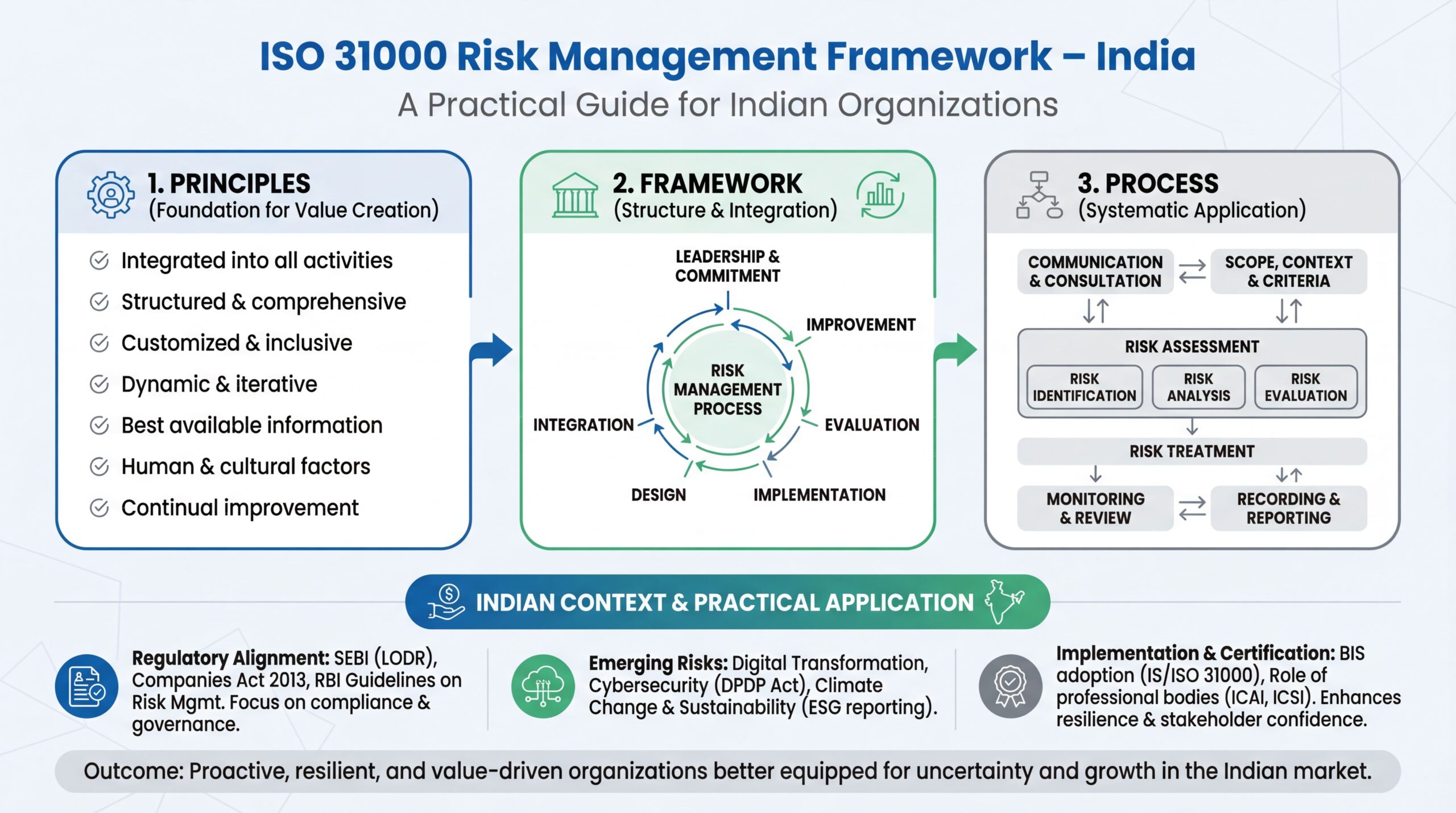
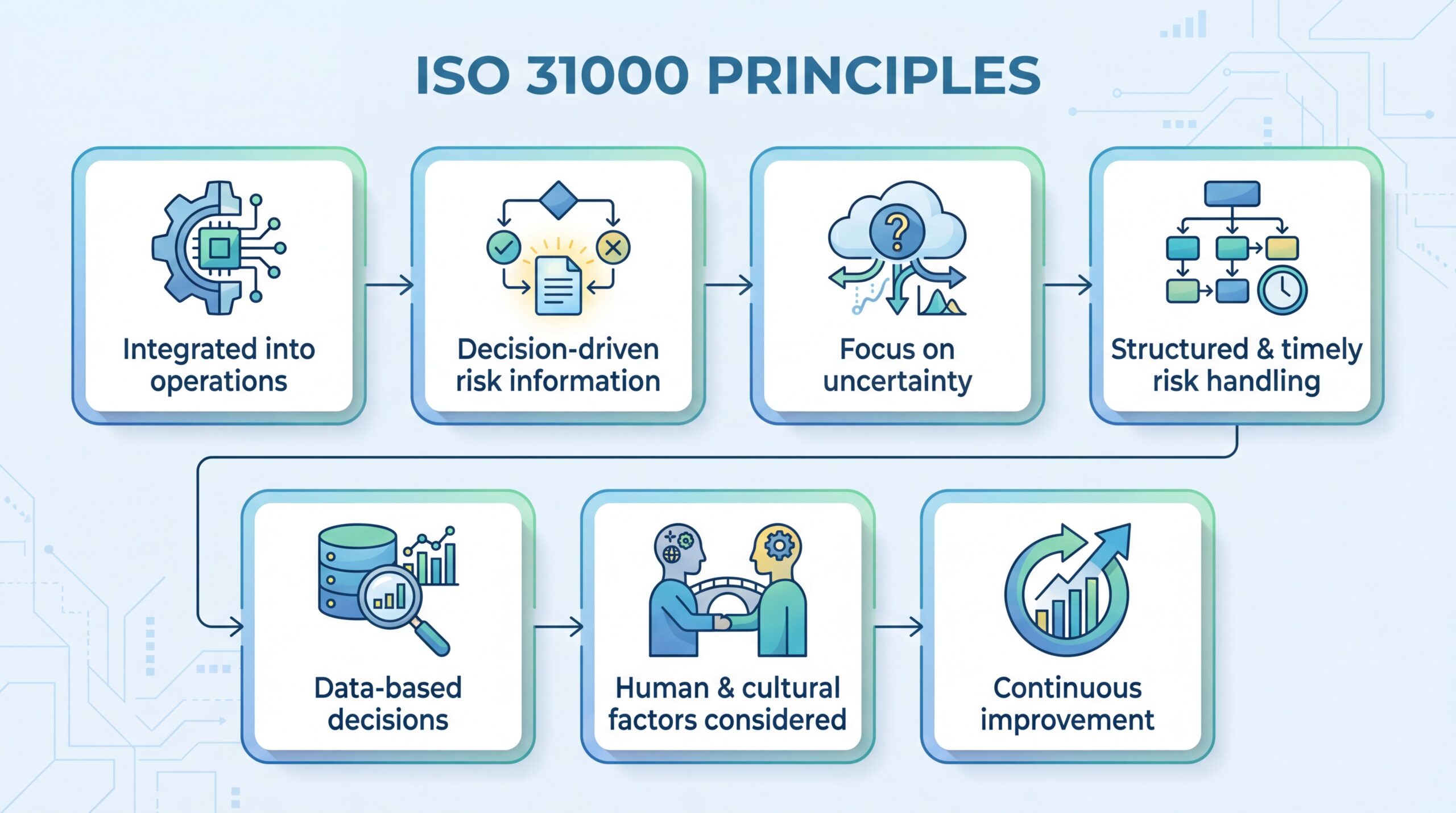
ISO 31000 Principles Explained
- We can integrate this across daily operations and core activities.
- Risk information guides better and more confident choices.
- It focuses on identifying and managing uncertainties.
- We can handle risks in a clear, organized, and prompt way.
- Decisions are based on the most accurate and up-to-date data available.
- Human behavior and workplace culture are taken into account.
- The system is flexible and updated as conditions change.
Documentation Requirements for ISO 31000
Here are the following documents required for ISO 31000:
Risk Register or Login
- Risk management policy
- Risk framework and roles document
- Risk assessment reports
- Risk treatment plans
- Monitoring and reviewing records
- Communication records
- Continuous improvement actions
ISO 31000 Risk Management Frameworks
Leadership & commitment for driving risk culture
Risk management integration in strategic and operational processes
Define context, roles, responsibilities, and resources.
Implementing the risk management process consistently
Assessing the effectiveness of the framework
Learning from incidents and audits to enhance the framework
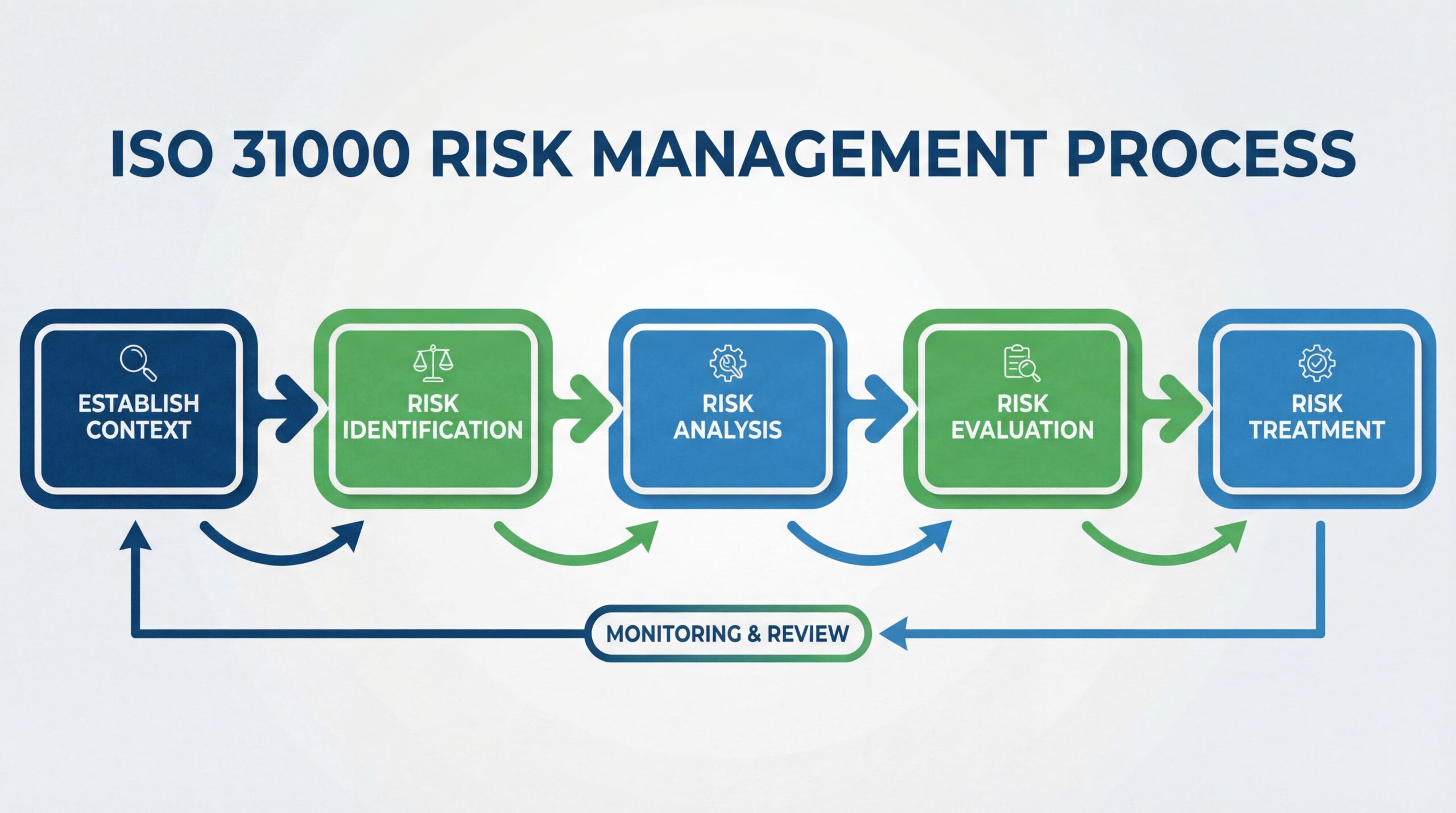
- Establish context to understand the internal or external environment and risk criteria.
- Risk identification for finding events or factors affecting objectives
- Risk analysis for assessing likelihood and impact (qualitative or quantitativ
- Risk evaluation that prioritizes risks against criteria
- Risk treatment for avoiding, reducing, transferring, and accepting
- Monitoring & review for tracking risks, updating registers, and adjusting plans.
ISO 31000 Implementation Process in India

Establish the Context
Here, we need to define the organizational internal environment (culture, structure, processes). Then we have to analyze the external environment (regulations, market, stakeholders) to set risk criteria.
Risk Identification
Here, we can survey the risk. Here are some tools used in India:
- Risk registers
- Brainstorming & workshops
- Historical data & lessons learned.
Risk Analysis
We can then analyze the risk using the following methods:
- Qualitative: High/Medium/Low
- Quantitative: Numerical probability and financial impact
- Hybrid approaches
Risk Evaluation
We have to decide which risk requires treatment, monitoring, and acceptance.
Communication and Consultation
After a thorough survey of potential risks, internal and external stakeholders should promote a risk awareness culture across all levels.
Timeframe for ISO 31000 implementation
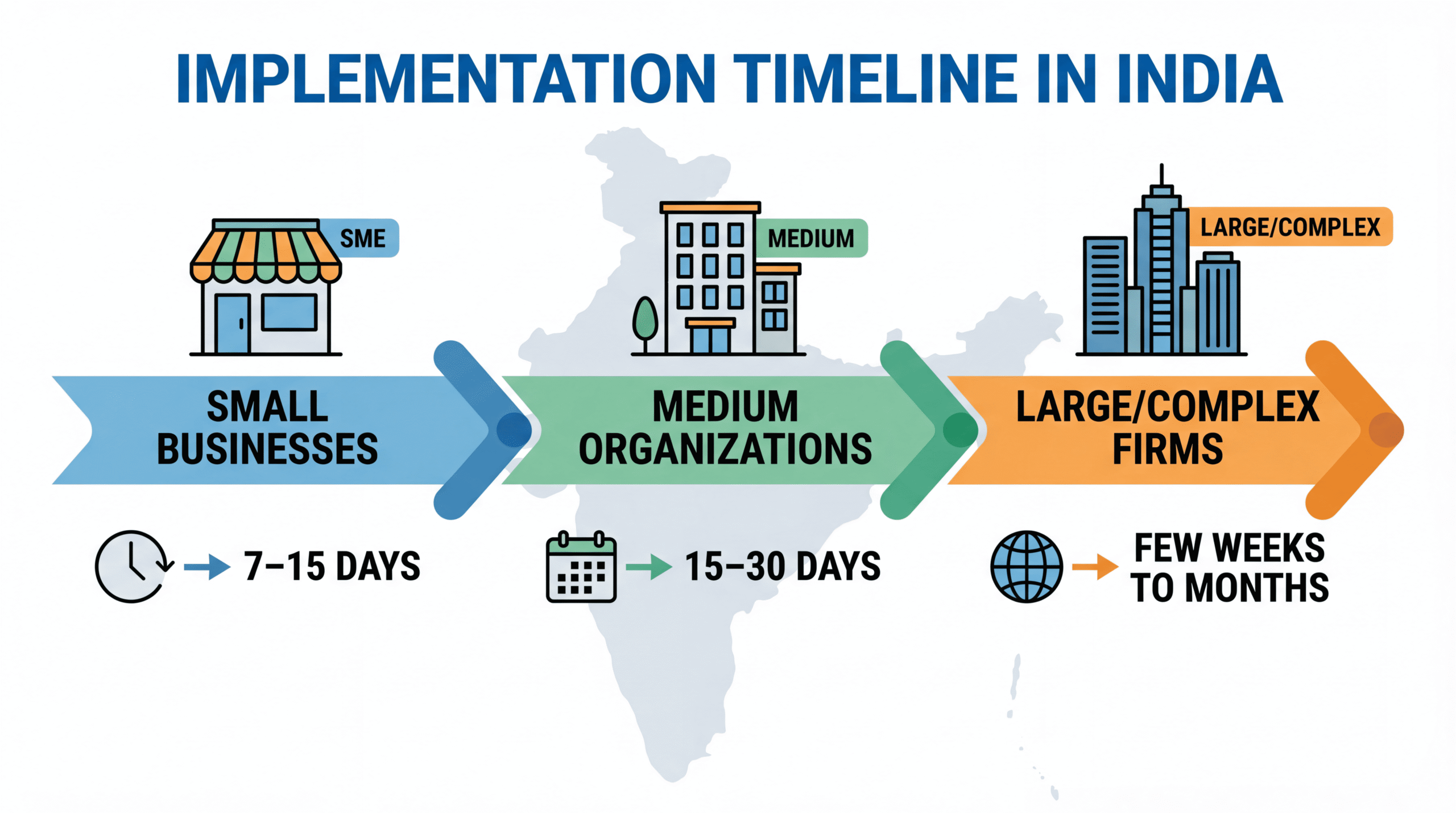
In India, the time frame may vary from –
- Seven to fifteen (Small Businesses/MSMEs)
- Fifteen to thirty working days (medium-sized organizations)
- A few weeks to several months (complex/large organizations)
Ongoing Risk Monitoring and Review
Risk monitoring and review are core elements under ISO 31000. Top management sets the direction for risk management. Monitoring ensures that preventive risk measures align with organizational strategy and objectives (updated time-to-time). Senior professionals establish risk policies and define accountability. They promote a strong risk-aware culture across the organization. It helps in ensuring that risk management is part of everyday decision-making.
Effective review under ISO 31000 also contains clear roles and oversight. Thorough review helps in monitoring risk performance and reviews outcomes regularly. This supports transparency, responsibility, and continuous improvement.
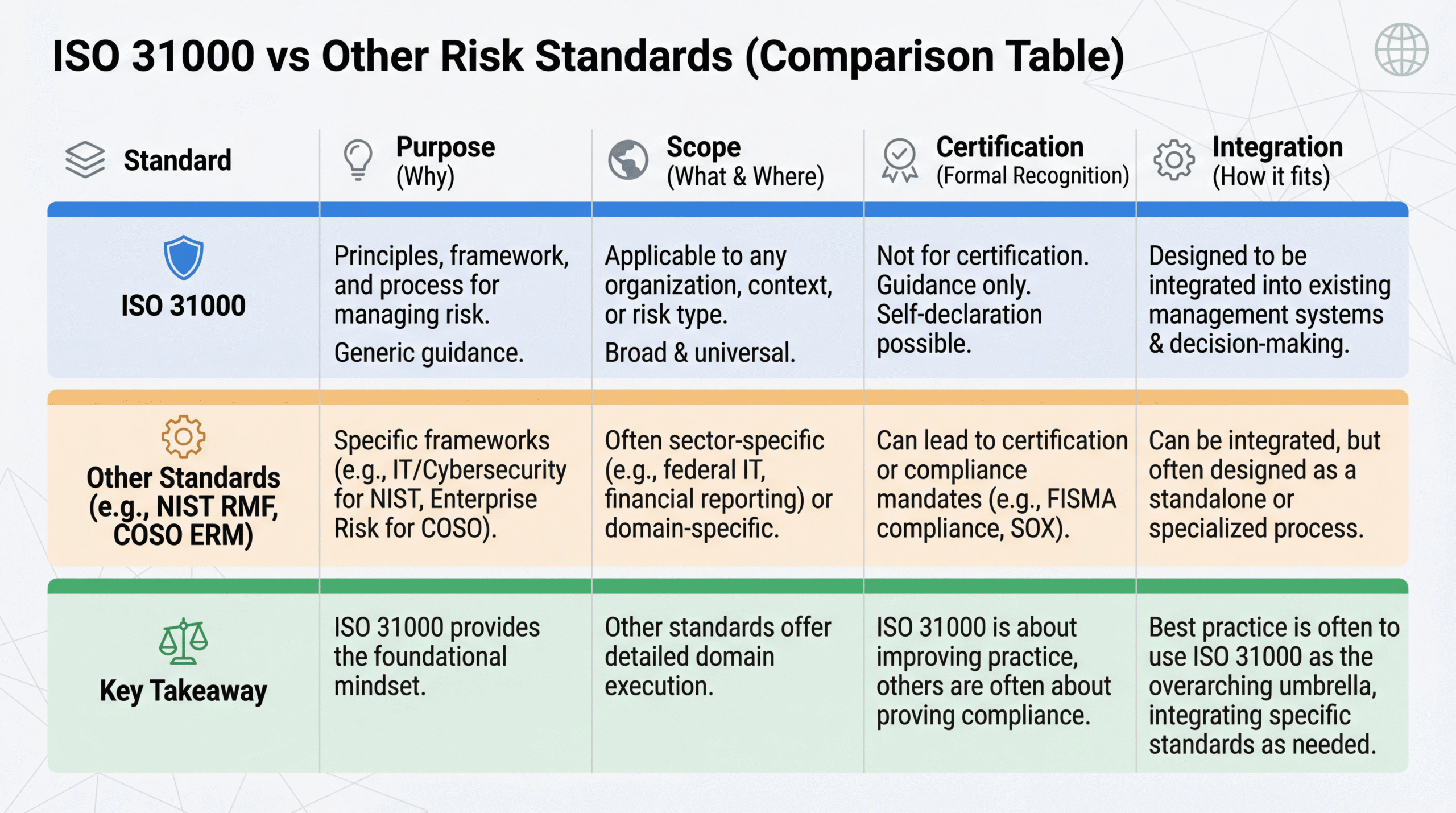
ISO 31000 vs. Other Risk Management Standards
| Feature/Aspect | ISO 31000 | Other Risk Standards (e.g., NIST RMF) |
| Purpose | Provides a flexible, principle-based framework for all types of risks | Often industry-specific, e.g., cybersecurity, operational risk |
| Scope | All organizations and risk types | Sector-specific (e.g., IT, healthcare, finance) |
| Certification | It is not a certification | Some may be tied to compliance requirements (e.g., NIST) |
| Integration | We can combine with other frameworks | It meets regulatory or technical standards |
ISO 31000 Implementation Cost in India
From 10,000 rupees to one lakh, the price may vary depending on the factors below:
Company size, complexity, and consultation fees
Why Choose Univate.in for ISO 31000 in India?
Univate.in is a globally recognized organization that offers expert risk management consulting backed by deep industry experience. Their team has delivered hundreds of successful consulting engagements across ISO standards and risk frameworks. These help organizations strengthen governance and compliance with structured risk practices.

Common Challenges in ISO 31000 Adoption(also explain how Univate makes things simple)
Many organizations struggle when top management does not fully support risk management.
Univate solution: They guide leadership to define risk policy, set risk appetite, and assign clear roles.
Employees often lack an understanding of risk management principles and practices.
Univate solution: They provide training and awareness programs for building a risk-aware culture.
It is often overwhelming to create risk registers, assessment reports, and monitoring systems.
Univate solution: They offer ready-to-use templates, frameworks, and documentation guidance.
Risk management can be disconnected from daily operations and decision-making.
Univate solution: It helps in aligning with ISO 31000 with current business processes, ensuring seamless integration.
Maintaining an ongoing, proactive risk system is challenging for many organizations.
Univate solution: They implement tools, dashboards, and processes for real-time risk monitoring and continuous improvement.